
Walk into a poorly ventilated shopping mall on a humid July afternoon in India and the experience communicates itself before you reach the first store. The air feels stale and heavy. Odours from food courts linger across floors. Shoppers move faster toward exits than escalators. Dwell time drops. Sales suffer.
Mall operators, facility managers, and commercial real estate developers across India face a common operational challenge: how do you maintain consistent, comfortable, and safe air quality across spaces that span hundreds of thousands of square feet, host thousands of visitors daily, and generate significant internal heat loads from lighting, equipment, and human occupancy?
The answer begins with selecting and deploying the right industrial fan for shopping mall ventilation — and building a comprehensive air movement strategy around it.
This guide covers what makes large commercial ventilation different, which fan technologies perform best in mall environments, and how a well-designed system protects visitor experience, staff wellbeing, and asset value simultaneously.
Why Large Commercial Spaces Demand Industrial-Grade Ventilation
Standard commercial fans and HVAC systems alone cannot solve the ventilation challenges that shopping malls, multiplexes, exhibition halls, and large retail complexes present. These environments combine multiple heat and contaminant sources in a single interconnected space — and the consequences of inadequate airflow cascade quickly.
Thermal load concentration — Food courts, anchor stores with high lighting loads, cinema halls, gaming zones, and crowded atriums each generate localised heat that standard air conditioning struggles to dissipate uniformly. Industrial ventilation fans break thermal stratification and distribute conditioned air across floor-level occupied zones where shoppers and staff actually spend their time.
Air quality deterioration — Food odours, cleaning chemical fumes, vehicle exhaust from basement parking, and CO₂ buildup from high occupancy all degrade air quality continuously throughout operating hours. Without active air exchange, these contaminants accumulate and create environments that trigger fatigue, headaches, and discomfort in visitors — all of which reduce time spent in the mall.
Humidity management — India’s monsoon season drives external humidity levels above 80–90% in most major cities. Mall entrances, service corridors, and basement levels experience humidity ingress that promotes mould growth on surfaces, damages merchandise displays, and creates slip hazards on hard-floor surfaces.
Emergency smoke management — Fire safety regulations under the National Building Code of India require large commercial spaces to maintain smoke control and extraction capability. Industrial ventilation fans form a critical component of compliant smoke management systems that protect life safety during emergencies.
Each of these challenges demands ventilation equipment designed for continuous heavy-duty operation — not residential or light commercial grade products.
The Right Industrial Fan for Shopping Mall Ventilation: Key Fan Types
High-Volume Axial Flow Exhaust Fans
Axial flow fans move large volumes of air along their rotational axis and suit the high-CFM requirements of mall ventilation perfectly. They integrate into ductwork systems, roof-mounted exhaust arrays, and wall-penetration exhaust points that remove stale air, food odours, and contaminants from specific zones.
In food court ventilation — one of the most demanding applications in any mall — axial flow fans extract grease-laden air, cooking odours, and combustion byproducts from above cooking stations before they migrate to adjacent retail and dining areas. Proper specification of blade pitch, motor power, and static pressure rating ensures these fans move adequate air volumes against the resistance of kitchen exhaust ductwork.
Large-Diameter HVLS (High Volume Low Speed) Air Circulators
High Volume Low Speed fans use very large blade diameters — typically 3 to 7 metres — rotating at slow speeds to move enormous volumes of air gently and efficiently. They create a floor-to-ceiling air column that spreads radially across the floor, continuously mixing stratified air layers and delivering uniform temperature and air quality throughout large open areas.
HVLS fans dramatically reduce the temperature difference between ceiling and floor levels — a gap that commonly reaches 8–12°C in large-volume retail spaces. By destratifying this air, HVLS fans allow HVAC systems to operate more efficiently, reducing compressor runtime and energy consumption while maintaining consistent comfort at floor level.
Wall-Mounted Heavy-Duty Exhaust and Circulation Fans
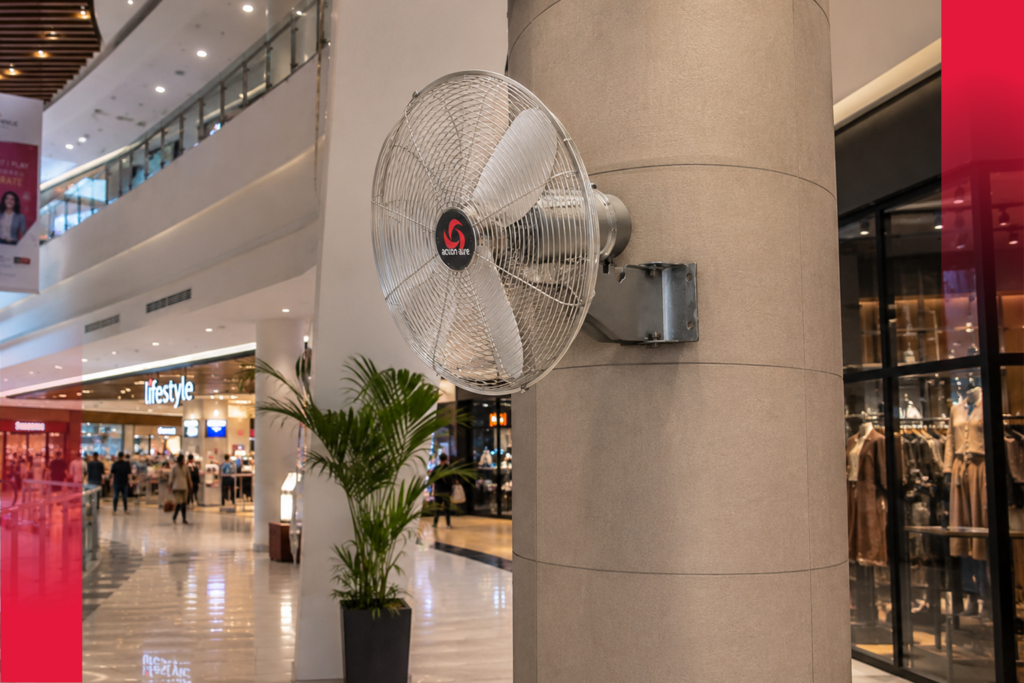
Wall-mounted industrial fans serve multiple functions in mall environments: targeted exhaust from service corridors, loading docks, basement parking levels, and utility areas; supplemental circulation in zones where HVAC coverage is limited; and emergency ventilation capacity when HVAC systems require maintenance.
Heavy-duty wall fans with Class F copper-wound motors, IP-rated housings, and precision-balanced aluminium blades deliver the reliability that 14–18 hours of daily mall operation demands. Variable tilt brackets allow facility teams to direct airflow precisely in response to occupancy patterns and seasonal changes.
Basement Parking Ventilation Fans
Basement parking in Indian malls generates the most concentrated air quality challenges in the entire facility. Vehicle exhaust produces carbon monoxide at levels that build rapidly in enclosed below-grade spaces. Regulatory compliance under the National Building Code and local fire department requirements mandates CO-monitored mechanical ventilation systems capable of achieving minimum air changes per hour.
Jet fans — specialised axial flow units mounted at ceiling level in parking structures — create longitudinal airflow patterns that sweep contaminants toward exhaust extraction points. They operate in coordination with CO sensors and automated controls to maintain safe air quality continuously.
Portable Industrial Blowers for Flexible Zone Management
Malls constantly reconfigure retail spaces for new tenants, seasonal displays, and promotional events. Portable industrial blowers provide the ventilation flexibility that fixed systems cannot match — delivering temporary airflow to renovation zones, construction areas, and event spaces without permanent installation.
High-capacity portable blowers on wheeled bases allow facility teams to respond quickly to localised air quality complaints, construction dust control needs, and emergency ventilation situations with a single versatile tool.
Performance Factors That Determine Real-World Ventilation Success
CFM accuracy — Always calculate required airflow based on actual space volumes and occupancy loads, not rule-of-thumb estimates. Shopping malls vary enormously in ceiling height, floor area, occupancy density, and internal heat generation. A food court zone requires far more air changes per hour than a fashion retail floor.
Motor endurance — Mall ventilation fans run 14–18 hours daily, 365 days a year. Copper-wound motors with Class F insulation, thermal overload protection, and quality bearings handle this duty cycle reliably. Fans with inferior motor specifications fail within months under continuous commercial loads, creating maintenance emergencies during peak trading hours.
Noise control — Shopper experience depends on acoustic comfort. Industrial fans in visible or near-occupant locations must carry documented noise ratings that meet commercial space standards. Select fans with aerodynamically optimised blades and vibration-dampening mounts to keep operational noise below levels that affect the shopping environment.
Energy efficiency — A large mall operating 50–100 ventilation fans continuously faces significant electricity costs. BLDC motors and precision blade designs reduce power consumption per CFM of airflow substantially. Evaluate total annual energy cost, not just purchase price, when comparing fan options.
Smart controls integration — Modern mall ventilation management integrates fans with building management systems (BMS), occupancy sensors, CO monitors, and temperature controllers. Specify fans compatible with variable frequency drives (VFDs) and BMS integration from the outset to enable demand-responsive ventilation that reduces energy waste during low-occupancy periods.
Ventilation Strategy for Different Mall Zones
Atrium and common areas — Deploy HVLS fans to destratify air and maintain uniform temperature. Position exhaust fans at high points to remove rising heat continuously.
Food courts — Combine powerful exhaust fans above cooking stations with makeup air supply systems to maintain neutral pressure balance. Prevent odour migration to adjacent retail zones through negative pressure management.
Cinema and entertainment zones — High occupancy and heat loads from projection equipment demand dedicated supply and exhaust systems with industrial fans providing backup and supplemental capacity.
Retail anchor stores — Large floor areas benefit from wall-mounted circulation fans that distribute conditioned air to far corners and high-bay storage areas beyond HVAC duct reach.
Basement parking — Install CO-monitored jet fan systems with automated controls. Maintain minimum 6 air changes per hour or per regulatory requirement, whichever is higher.
Service corridors and loading docks — Heavy-duty exhaust fans remove vehicle fumes, cleaning chemical odours, and heat from these high-use service areas before they penetrate retail floors.
Why Action Aire Delivers the Best Industrial Fan for Shopping Mall Ventilation in India
With over three decades of in-house manufacturing expertise, Action Aire produces every component — from copper motor winding to precision aluminium blade fabrication to powder-coated housings — under direct quality control. This end-to-end manufacturing discipline ensures consistent performance across every unit, whether a mall project requires 10 fans or 200.
Action Aire’s product range covers the full spectrum of commercial ventilation requirements: heavy-duty wall-mounted exhaust fans, axial flow units, man coolers, portable blowers, and weatherproof air circulators — all built to handle the continuous duty cycles that large commercial facilities demand. Proven performance across India’s most demanding clients — including theme parks, automotive manufacturing plants, and railway facilities — demonstrates the reliability that high-footfall commercial environments require.
Custom specifications, flexible mounting configurations, export-grade build quality, and dedicated after-sales support make Action Aire a complete ventilation partner for mall developers, facility management companies, and MEP consultants working on large commercial projects anywhere in India.
Conclusion
Effective ventilation in shopping malls and large commercial spaces directly protects visitor comfort, staff health, asset integrity, and regulatory compliance. The right Industrial fan for shopping mall ventilation India does not simply move air — it creates the environmental conditions that keep shoppers comfortable, encourage longer dwell times, support retail performance, and protect the long-term value of one of your most significant infrastructure investments.
Choose fan technologies matched to your specific zone requirements. Build a layered strategy that addresses heat, humidity, contaminants, and emergency scenarios simultaneously. Partner with a manufacturer whose engineering depth, product range, and field-proven reliability can support your project from specification through commissioning and beyond.
The malls that deliver consistently excellent visitor experiences invest in the systems that make those experiences possible — and ventilation sits at the top of that list.
Frequently Asked Questions
How do I calculate the number of industrial ventilation fans a shopping mall needs?
Calculate the total volume of each zone separately — multiply length by width by ceiling height to get cubic metres. Determine the required air changes per hour for each zone type: retail areas typically need 6–10 changes, food courts need 20–30 changes, and basement parking requires a minimum of 6 changes or whatever local regulations mandate. Divide zone volume by 60 and multiply by required air changes per hour to get required CFM per zone. Divide this figure by the rated CFM of your selected fan model to determine the minimum unit count. Always add 20% additional capacity for redundancy and performance degradation over time.
What is the most energy-efficient ventilation fan option for a large mall running 16+ hours daily?
BLDC (Brushless Direct Current) motor fans deliver the highest energy efficiency for continuous commercial operation — consuming up to 50% less electricity than conventional induction motor fans at equivalent airflow output. For large open areas, HVLS fans provide exceptional energy efficiency per square metre covered due to their high-volume low-speed operating principle. Pair either technology with variable frequency drives and BMS-linked occupancy sensing to further reduce energy consumption during lower-footfall periods such as early morning and late evening operating hours.
How do industrial ventilation fans work alongside a mall’s central HVAC system?
Industrial ventilation fans and central HVAC systems serve complementary functions. HVAC systems condition air — cooling, heating, and dehumidifying. Ventilation fans distribute that conditioned air, remove contaminants, manage pressure zones, and provide air exchange that HVAC recirculation systems alone cannot deliver. In practice, well-positioned HVLS and circulation fans allow HVAC systems to achieve target temperatures with less compressor runtime by eliminating thermal stratification — reducing HVAC energy consumption by 15–30% in large-volume spaces. Ventilation fans also provide critical backup air movement when HVAC components require scheduled maintenance.
What IP rating should ventilation fans carry in mall food courts and basement parking areas?
Food court areas with grease, steam, and regular cleaning require minimum IP55 rated fans — fully dust-protected with resistance to water jets. Basement parking areas with vehicle splash, drainage water, and cleaning washdowns need IP65-rated fans that provide complete dust protection and resistance to directed water spray. Any fans installed in outdoor service areas, rooftop plant rooms, or areas directly exposed to monsoon rainfall should carry IP65 ratings as a minimum standard. Always verify that the IP rating covers the motor housing, junction box, and any external electrical connections — not just the fan housing.
How frequently should industrial ventilation fans in a shopping mall be serviced?
Inspect fan blades and guards monthly for dust and grease buildup — contamination reduces airflow efficiency by up to 25% and significantly increases motor load. Clean blades and guards at minimum quarterly or more frequently in food court zones where grease accumulates rapidly. Lubricate motor bearings every three to six months according to manufacturer specifications and operating hour logs. Check mounting hardware, vibration-dampening mounts, and structural fixings every six months. Test motor thermal protection and electrical connections annually. Schedule a comprehensive performance assessment — measuring actual airflow output against rated specifications — every two years to identify fans approaching end of service life before they fail during peak mall trading periods.