
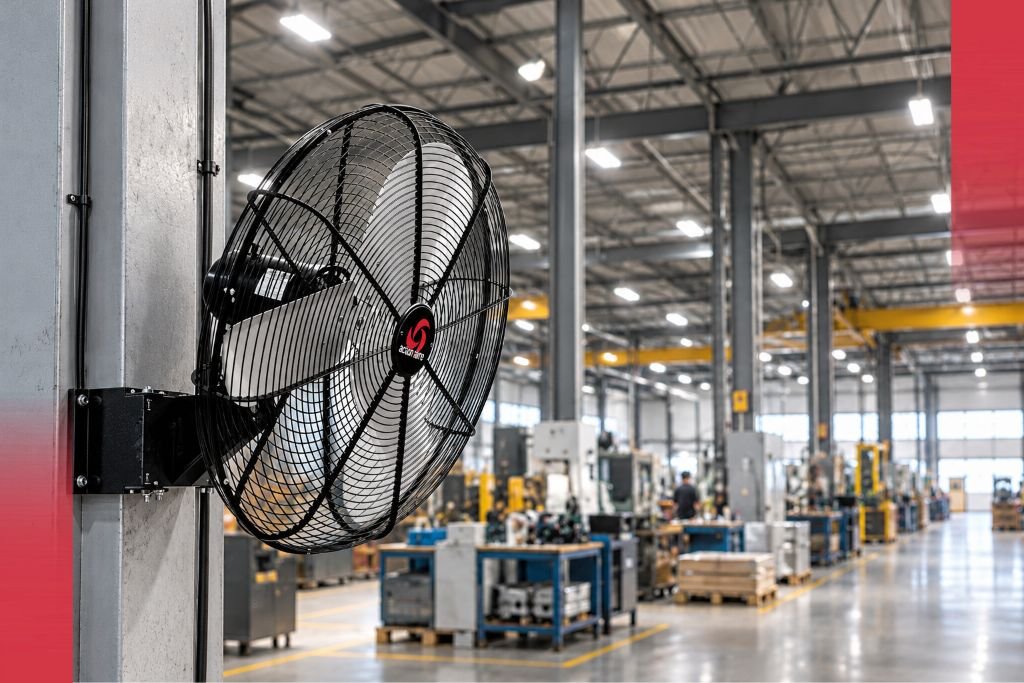
Every summer, plant managers type the same question into Google: how many industrial fans do I need for my shed? The answer usually comes back as a vague “it depends”. That does not help when you have a purchase request to raise this week. The good news is that you can reach a sensible estimate with a tape measure, a floor plan and the throw distance of the fan you plan to buy. This guide shows a practical, layout-based method, walks through a worked example for a 10,000 square foot factory and explains where Action Aire heavy duty wall fans fit.
Why Floor Area Alone Does Not Answer the Question
Two factories can share the same 10,000 square feet and still need very different fan counts. A long, narrow shed with machines along both walls behaves very differently from a square warehouse with open aisles.
Four things change the answer:
- Shape of the building: Fans throw air in one direction. Wide buildings need extra fans in the middle.
- Obstructions: Racks, machines, mezzanines and partitions break up the air stream.
- Where people work: Fans should cover the occupied zones first, not empty storage corners.
- Heat load: Furnaces, ovens, compressors and tin roofs raise the comfort demand in some zones.
That is why a layout-based method works better than a single “fans per square foot” number.
What Fans Actually Do in a Factory
An industrial air circulator fan moves the air already inside the building. Moving air over the skin helps sweat evaporate, so workers feel cooler. It does not lower the air temperature like an air conditioner, and it does not bring in fresh outdoor air.
If your shed also traps hot air, smoke or fumes, you need exhaust ventilation alongside your circulators. This guide focuses on circulation fans for worker comfort.
How Many Industrial Fans Do I Need? A Four-Step Method
Step 1: Draw the floor plan
Sketch the building to scale. Mark walls, columns, machines, racks, doors and the main work zones. Note the clear wall height available for mounting.
Step 2: Check the throw distance of your fan size
Throw distance tells you how far a fan pushes useful air. Action Aire’s catalogue includes an air flow chart for its industrial air circulators. It shows throw growing with size, from roughly 17 feet for the 18 inch fan, about 20 feet for 20 inch, about 25 feet for 24 inch and about 30 feet for the 30 inch model.
Step 3: Cover the walls first
Wall fans cover a band of floor along each wall, about as deep as their throw. Place them along the long walls, spaced so their air streams overlap slightly. Oscillation widens each fan’s coverage, since the catalogue lists a 90 degree sweep on its heavy duty models.
Step 4: Fill the centre
Any floor area beyond the reach of the wall fans needs extra coverage. Pedestal fans or additional wall fans on columns fill this gap.
Worked Example: Fans for a 10,000 Sq Ft Factory
Imagine a factory shed 100 feet long and 100 feet wide, with workstations spread across the floor and walls high enough for mounting.
Wall coverage. Choose 30 inch heavy duty wall fans with a throw of about 30 feet. Fans on each long wall cover a band about 30 feet deep. Together, the two walls cover about 60 feet of the 100 foot width.
Spacing along the walls. With oscillation, placing fans roughly every 25 feet along each 100 foot wall gives four fans per wall. That makes eight wall fans.
The centre strip. A 40 foot strip remains in the middle. Three or four heavy duty pedestal fans, or wall fans fixed on central columns, can cover the main workstations in that strip.
Estimated total: about 11 to 12 fans.
Treat this as a starting estimate, not a final design. A shed full of tall machines may need more fans. An open warehouse with few workers in the centre may need fewer. Always confirm the plan with a trial run or a site survey.
Wall Fans or Pedestal Fans for the Centre?
The centre of a wide shed is where most fan plans go wrong, so it deserves its own decision.
Choose pedestal fans when work zones in the middle change often, when you lack columns to mount fans on, or when you want to move airflow between lines during the day. A height adjustable pedestal also lets you aim air at seated or standing workers.
Choose column-mounted wall fans when floor space is tight, when forklifts and trolleys move through the centre, or when the work zones stay fixed for years. Fans above head height stay out of the way, and no trolley can knock them over.
Many factories use both: wall fans on columns along the main aisles, and a few pedestal fans that supervisors move to wherever the heat builds up that day.
Choosing the Right Fan Size
Bigger is not always better. A 30 inch fan in a narrow bay can feel too strong for nearby workers, while an 18 inch fan in a wide shed leaves the middle untouched.
According to the official Action Aire catalogue, the heavy duty wall fan comes in these sizes:
- 18 inch: 1/6 HP, 100W, 125 m³/min air delivery
- 20 inch: 1/6 HP, 120W, 140 m³/min air delivery
- 24 inch: 1/4 HP, 200W, 263 m³/min air delivery
- 30 inch: 1/4 HP, 250W, 370 m³/min air delivery
All four are oscillating models. The 18, 20 and 24 inch sizes run at 1400, 1200 or 1000 RPM, while the 30 inch runs at 1400 RPM. The catalogue states that performance figures generally conform to IS:2997, the Indian Standard for air circulator fans.
As a rule of thumb, use 24 and 30 inch fans for wide sheds and high walls, and 18 or 20 inch fans for narrow bays, mezzanines and smaller work areas.
Common Fan Sizing Mistakes
Buying by budget, not layout. A fixed number of fans placed without a plan leaves dead zones.
Ignoring the centre. Wall fans alone rarely reach the middle of a wide building.
Pointing fans at each other. Fans on opposite walls should push air in the same direction around the room, not collide in the middle.
Mounting too high without tilt. Air that passes over workers’ heads does nothing for comfort. Angle fans down towards chest height.
Forgetting power planning. Ten to twelve fans add up. At the catalogue ratings, eight 30 inch fans draw 2,000W together at full speed. Check that your supply and wiring can carry the load.
Running Cost for a 10,000 Sq Ft Fan Plan
Running cost follows a simple formula: wattage multiplied by hours, divided by 1,000, gives units (kWh). Using the worked example, eight 30 inch wall fans at 250W and four 24 inch pedestal fans at 200W draw 2,800W together. Over a 10 hour shift, that comes to 28 units. Multiply by your own tariff per unit for the daily cost.
Lower speed settings reduce consumption, so supervisors can match fan speed to the weather and the shift.
Why Buyers Choose an Action Aire Heavy Duty Fan
Action Aire, the industrial fan brand of M.D. Equipments Pvt Ltd, has been building fans since it began in 1991 as an engineering and stamping facility in Noida. As an industrial fan manufacturer in India with over three decades of experience, the company runs in-house production at its manufacturing unit in Mundra, Gujarat.
The catalogue describes motors with 100% Class F copper winding and thermal overload protection, guards with a wire gap of 10 mm or less, and an intelligent wall bracket for flexible positioning. Its timeline records supplies to Northern Railways and to industrial customers such as Honda, Hero and Tata. For a broader view of fan types, read our guide on how to choose the right industrial fan for your factory or warehouse.
Get a Fan Count You Can Trust
So, how many industrial fans do you need? For a typical 10,000 square foot factory, a layout-based plan often lands around 10 to 12 fans, using wall fans along the long sides and pedestal fans in the centre. Your building shape, machines and heat sources decide the final number.
Explore the full range of Action Aire industrial air circulators, or share your floor plan, wall height and work zones with the team through the contact page. As a Make in India industrial fan manufacturer, Action Aire can help you finalise a fan layout and quotation.
Frequently Asked Questions
How many industrial fans do I need for a 10,000 sq ft factory?
A layout-based plan for a square 10,000 sq ft shed often lands around 10 to 12 fans, using wall fans along the long sides and pedestal fans in the centre. Machines, heat sources and building shape change the final count.
How do I calculate the number of fans for a factory?
Draw the floor plan, check the throw distance of your fan size, cover the long walls with overlapping wall fans, then fill the centre with pedestal or column-mounted fans.
How far does a 30 inch industrial fan throw air?
Action Aire’s catalogue air flow chart shows its 30 inch industrial air circulator reaching roughly 30 feet.
Is a bigger industrial fan always better?
No. A large fan in a narrow bay can feel too strong for nearby workers. Match the fan size to the width of the area and the distance to the workers.
How much electricity do 10 industrial fans use?
Multiply each fan’s wattage by its running hours and divide by 1,000 to get units. Ten 250W fans running for 10 hours use 25 units at full speed.
Do industrial fans reduce factory temperature?
No. Industrial air circulator fans move air over workers to help them feel cooler, but they do not lower the air temperature. Exhaust ventilation removes hot air from the building.
Does Action Aire manufacture heavy duty wall fans in India?
Yes. Action Aire manufactures its heavy duty wall fans in India, with in-house production at its unit in Mundra, Gujarat, and more than three decades of manufacturing experience.
Where can I buy industrial fans in bulk for a factory?
You can buy directly from a heavy duty fan manufacturer such as Action Aire by sharing your floor plan, fan sizes and quantity through its contact page for a quotation.