
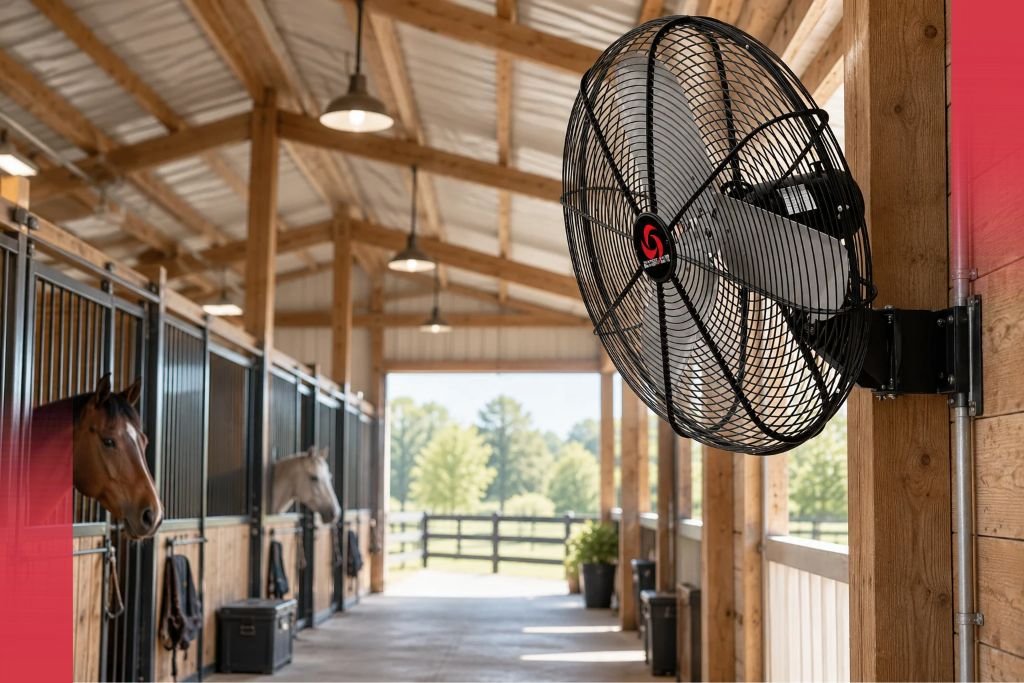
Walk into a closed stable on a hot afternoon and you notice it straight away. The air feels heavy, it smells of ammonia, and dust hangs in the light. Horses spend many hours in that air. A good fan for horse stable ventilation keeps air moving through aisles and stalls. A heavy duty wall fan does that from above head height, out of the way of horses and handlers. But a barn is a tough place for any machine, so check these seven features before you buy.
Why Stable Ventilation Deserves Attention
Penn State Extension, in its horse facilities series, calls inadequate ventilation the most common mistake in modern horse facilities. It explains that the goal of ventilation is simple: get fresh air to the horse. The same publication notes that veterinarians and professional horse handlers recommend good ventilation for stabled horses to maintain respiratory health.
Good stable design starts with openings. Penn State describes eave openings, ridge vents, doors and windows as the foundation of natural ventilation. Its boarding guidance adds that forced-air systems may become necessary in barns without enough natural airflow.
Fans come in at that point. They help move air through spaces where natural airflow falls short, especially on still, hot days. They support good barn design. They do not replace it.
7 Features to Check in a Heavy Duty Wall Fan for Horse Stable Ventilation
1. Airflow You Can Aim
A stable fan should put air where horses and handlers actually are. Look for tilt adjustment, so you can angle airflow down into stalls or along the aisle. Oscillation also helps one fan cover a wider stretch of stalls.
The Action Aire heavy duty wall fan offers both options. Its catalogue lists oscillating (OST) and non-oscillating (non-OST) models, with a 90-degree sweep or direct airflow with cushion tilt adjustment.
2. Wall Mounting That Keeps the Fan Out of Reach
Horses are curious and strong. A fan placed within reach invites chewing, knocking or rubbing. A wall fan sits above head height and off the floor, where it could otherwise trip handlers or block aisles.
Action Aire’s website describes an intelligent wall bracket that allows flexible fan positioning. Before installation, check that the wall, beam or post can hold the fan’s weight and vibration. Route electrical cables well out of reach, and use a qualified electrician for barn wiring.
3. Guard Spacing
A strong, close-spaced guard protects curious noses, handlers’ fingers and stable cats from the blades. Ask for the exact wire gap. Action Aire’s website states that its fan guards use wire spacing of 10 mm or less, and the catalogue says the guards meet international safety standards.
4. Motor Protection for Dusty Barns
Hay, bedding and arena footing all create fine dust. That dust can settle on motors and cause overheating over time. Choose a fan with automatic thermal overload protection, which switches the motor off if it gets too hot.
The heavy duty wall fan includes automatic thermal overload protection, according to the catalogue. It also uses pre-lubricated ball bearings for smooth operation, and Action Aire’s website states that its in-house motors use Class F copper winding.
5. A Finish That Resists Barn Conditions
Stables deal with humidity, urine vapour and cleaning routines. Bare metal suffers in these conditions. The heavy duty wall fan has a powder-coated finish, which the catalogue describes as long-lasting. It also offers customisable colour schemes, useful if your stable follows a set look.
Keep in mind that the catalogue does not list a weatherproof rating for this model. Mount it under cover, away from direct rain, hose spray and wash bay water.
6. Speed Control and Balanced Running
Different seasons and times of day need different airflow. The catalogue lists 2 or 3-speed 230-volt motors. The 18, 20 and 24 inch models run at 1400, 1200 and 1000 RPM, while the 30 inch model runs at a single 1400 RPM speed. Dynamically balanced blades help the fan run smoothly, which matters in a calm barn environment.
7. Easy Cleaning and Maintenance
Dust builds up on guards and blades and reduces airflow. Choose a fan you can reach and clean without special tools. The catalogue notes an easy assembly process, which also makes routine access simpler.
Heavy Duty Wall Fan Specifications
The official Action Aire catalogue lists these models:
| Model | Size | Motor (HP) | Speed (RPM) | Wattage | Air Delivery |
| 18-HDWF | 18″ | 1/6 | 1400/1200/1000 | 100W | 125 m³/min |
| 20-HDWF | 20″ | 1/6 | 1400/1200/1000 | 120W | 140 m³/min |
| 24-HDWF | 24″ | 1/4 | 1400/1200/1000 | 200W | 263 m³/min |
| 30-HDWF | 30″ | 1/4 | 1400 | 250W | 370 m³/min |
These figures belong to these specific models. The catalogue states that performance figures generally conform to IS:2997 and that specifications may change with ongoing development. You can see the wider heavy duty air circulator fans page for more on the series.
Smaller sizes often suit individual stall rows, where too much air can blow bedding around. Larger sizes suit long aisles and open barn areas. Confirm the right size for each spot with the manufacturer.
Where to Mount the Fan in a Stable
Think about the path air should take through the building. Good mounting spots often include:
- Aisle ends, where a fan can push air down the length of the barn
- Walls or posts between stall rows, angled so air moves through stall fronts
- Above grooming and tacking areas, where handlers spend time with horses
- Near feed rooms and wash-down zones kept under cover, where warm, damp air tends to collect
Keep every fan well above the reach of a horse standing on its hind legs, and leave clear access for cleaning.
Fans Support Ventilation. They Do Not Replace It.
Even a well-chosen fan cannot fix a stable with no fresh air openings. If your barn smells of ammonia even with fans running, look first at eave and ridge openings, manure removal and bedding management. Penn State’s horse stable ventilation publication offers detailed guidance on openings and airflow paths.
Mistakes Stable Owners Often Make
Blowing air straight into a horse’s face at close range. Strong, direct air at head height can stir up dust from hay nets. Aim fans so air moves through the stall rather than at the eyes.
Hanging cords across stalls or aisles. Loose cords invite chewing and create trip hazards. Plan outlets and cable routes before installation.
Blocking natural airflow. A fan pushing air against the path from eave to ridge can work against the barn’s natural ventilation. Place fans so they help air follow its existing route.
Forgetting the seasons. A setup that works in summer may create unwanted drafts in cooler months. Use the speed settings and tilt to ease airflow back.
How Many Fans Does a Stable Need?
No honest supplier can give one number for every stable. The right count depends on aisle length, stall count, ceiling height, natural openings and local climate. Sketch the barn with stalls, doors and openings marked. Note where air already moves well and where it feels still, then place fans to fill the still areas first.
A Simple Maintenance Routine
Wipe dust from guards and blades during routine barn cleaning. Check brackets and fixings for looseness, since vibration and curious horses can work them loose. Look at cords and plugs for chewing or wear. Before each hot season, run every fan at each speed and listen for new noise. Always switch off power before cleaning or inspecting a fan.
Plan Your Stable Airflow
The right fan for horse stable ventilation moves air where horses stand, stays out of their reach, survives dust and cleans up easily. The heavy duty wall fan covers those needs with wall mounting, a close-spaced guard, thermal protection and adjustable airflow. For more on choosing air circulators, read how to choose the right industrial fan.
Share your stable layout, aisle length, ceiling height and number of stalls with Action Aire through the contact page. The team can help you pick the right heavy duty wall fan size for each area.
FAQs
Do horse stables need fans?
Many stables rely on natural openings for fresh air. Penn State Extension notes that forced-air ventilation may become necessary when natural ventilation is not enough.
Why use a wall-mounted fan in a horse stable?
A wall fan sits above the horses’ reach and keeps aisles clear. It also lets you angle airflow down into stalls.
Does the heavy duty wall fan oscillate?
Action Aire’s catalogue lists both oscillating and non-oscillating models, with a 90-degree sweep or fixed airflow with tilt adjustment.
What sizes does the Action Aire heavy duty wall fan come in?
The catalogue lists 18, 20, 24 and 30 inch models, with air delivery from 125 to 370 m³/min.
Can I use the heavy duty wall fan in a wash bay?
The catalogue does not list a weatherproof rating for this model, so mount it under cover and away from hose spray and direct water.
What is the most common stable ventilation mistake?
Penn State Extension identifies inadequate ventilation as the most common mistake in modern horse facilities.
Can fans fix an ammonia smell in a stable?
Fans help move air, but ammonia usually points to poor openings, manure buildup or bedding issues. Address those first.