
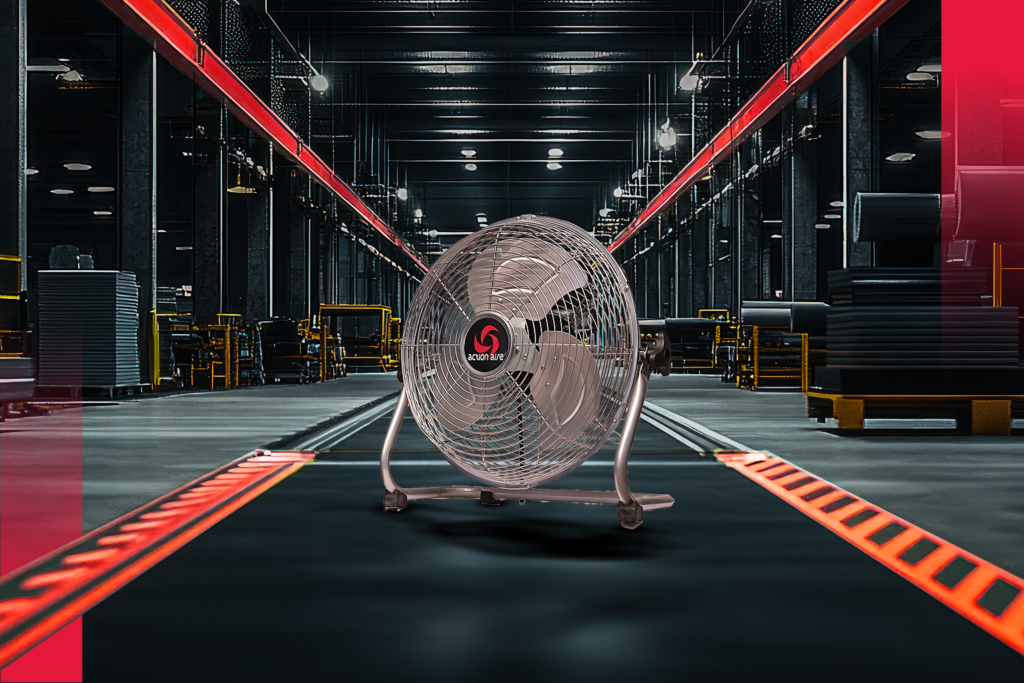
Walk into any large manufacturing facility in India on a summer afternoon and you immediately understand the stakes. The temperature near machinery can exceed 45°C. Fumes from welding, painting, and chemical processing hang in the air. Workers slow down, make errors, and face genuine health risks. Equipment runs hotter than designed, reducing accuracy and shortening service life.
Poor ventilation does not just create discomfort — it creates liability.
Every plant manager, facility engineer, and operations director searching for the right factory ventilation fan faces the same core problem: large industrial and manufacturing spaces are difficult to ventilate effectively. High ceilings, massive floor areas, heat-generating machinery, and varied occupancy zones all demand a ventilation strategy built around the right equipment.
This guide covers the best fan options available for large industrial and manufacturing spaces, the key performance factors you must evaluate, and the installation strategies that deliver results across real-world Indian factory conditions.
Why Large Industrial Spaces Demand Specialised Factory Ventilation Fans
A domestic fan moves air at 200–400 CFM. A large factory floor may require 50,000 to 200,000 CFM of total airflow to achieve adequate ventilation. That gap tells you everything about why standard fans fail in industrial settings and why purpose-built factory ventilation equipment is non-negotiable.
Large facilities present several unique ventilation challenges:
Heat stratification — Hot air rises and concentrates near ceilings, while workers and machines at floor level continue generating heat. Without active downward airflow, temperatures at working height remain dangerously high even when ceiling temperatures theoretically allow heat escape.
Fume and contaminant zones — Welding stations, painting booths, chemical mixing areas, and diesel-powered vehicle zones generate localised concentrations of harmful gases. General airflow alone does not remove these; targeted exhaust at the source is essential.
Uneven occupancy — A warehouse may have 80% of its workforce concentrated in 30% of the floor space. Uniform ventilation wastes energy and leaves occupied zones underserved.
Seasonal variation — Indian factories operate through monsoon humidity, summer extremes, and winter cold. A ventilation system that solves one season can fail another.
Understanding these challenges helps you select the right fan type, the right configuration, and the right number of units for your facility.
The Best Factory Ventilation Fan Types for Industrial and Manufacturing Spaces
-
Heavy-Duty Wall-Mounted Exhaust Fans
Wall-mounted exhaust fans form the backbone of most industrial ventilation strategies. They mount at high points on factory walls, draw hot contaminated air out, and create negative pressure that pulls fresh air in through intake vents on the opposite side.
The best heavy-duty wall fans for industrial use feature:
- Class F copper-wound motors with thermal overload protection for continuous operation
- High-grade aluminium blades precision-bent (not cast) for consistent aerodynamic performance
- IP55 or higher ratings for dust and water resistance
- Adjustable tilt brackets for directional airflow control
- Wire guards with ≤10mm spacing for operator safety
In a 10,000 sq ft assembly plant, a correctly specified set of wall-mounted exhaust fans on the leeward side of the building — combined with louvered intake vents on the windward side — can achieve complete air changes every 3–5 minutes.
-
Axial Flow Exhaust Fans
Axial flow fans move large volumes of air along their rotational axis. They work extremely well in duct-connected exhaust systems, roof-mounted ventilation arrays, and inline applications where air must travel through confined pathways.
For large manufacturing spaces with process-specific exhaust needs — paint booths, chemical storage rooms, battery charging areas — axial flow units deliver high CFM at relatively low static pressure. They suit applications where air needs to move long distances through ductwork or across large open bays.
Key selection criteria include blade pitch, diameter, static pressure rating, and motor speed. Always match the axial fan’s rated performance curve to your duct system’s resistance profile.
-
Man Coolers and Portable Blowers
Not every ventilation challenge in a factory is structural. Spot cooling at workstations, temporary ventilation during maintenance shutdowns, and emergency fume clearance all require portable solutions that operators can deploy and reposition quickly.
Man coolers deliver high-velocity concentrated airflow to specific workstations — ideal for operators working near furnaces, boilers, or press machines. They mount on adjustable stands, direct precisely, and provide meaningful thermal relief without requiring permanent installation.
Portable blowers serve construction, maintenance, and confined-space ventilation. They provide strong directional airflow in areas where fixed fans cannot reach and are essential tools in any facility’s safety and maintenance toolkit.
-
Pedestal and Floor-Mounted Air Circulators
Large open factory floors — automotive assembly lines, textile mills, logistics warehouses — need uniform air circulation across wide horizontal areas. Floor-mounted and pedestal air circulators achieve this by moving large volumes of air at mid-height, creating continuous movement patterns that prevent hot pockets from forming.
Heavy-duty pedestal fans with wide oscillation ranges cover large floor areas efficiently. They complement exhaust fans by keeping air in motion between extraction points, improving temperature uniformity and worker comfort across the entire production floor.
-
Weatherproof and Waterproof Air Circulators
Food processing plants, dairy facilities, beverage manufacturers, and outdoor industrial areas require fans that withstand direct water exposure, cleaning chemical spray, and high-humidity environments. Standard fans corrode, short-circuit, and fail rapidly in these conditions.
IP65-rated weatherproof fans use sealed motor housings, corrosion-resistant coatings, and moisture-proof wiring to deliver reliable performance in wet environments. They meet food industry hygiene requirements while providing the airflow volumes that large processing halls demand.
Key Performance Factors to Evaluate Before You Buy
CFM output — Calculate your required airflow using: (Length × Width × Height × Air Changes per Hour) ÷ 60. Industrial facilities typically need 6–20 air changes per hour depending on heat load and process type.
Motor durability — Copper winding, Class F insulation, and thermal overload protection are minimum requirements for continuous industrial duty. Fans without these specifications fail prematurely under the loads Indian factory environments impose.
Blade material and balance — Dynamically balanced, precision-formed aluminium blades deliver consistent airflow, minimise vibration, and extend bearing life. Avoid cast or moulded blades in high-load applications.
Energy efficiency — Industrial fans run thousands of hours per year. A 10% reduction in power consumption translates to significant annual savings at scale. Evaluate watts per CFM, not watts alone.
Noise levels — The Factories Act mandates noise limits in Indian workplaces. Specify fans with documented decibel ratings and ensure they comply with applicable occupational health standards at your installation distance.
Spare parts and service support — A fan that breaks down and cannot be repaired quickly costs more in lost production than the fan itself. Choose manufacturers who stock critical spare parts and provide responsive after-sales support.
Ventilation Strategy: Combining Fan Types for Maximum Coverage
The most effective ventilation systems in large industrial and manufacturing spaces use multiple fan types in a coordinated strategy rather than relying on a single fan category.
A proven approach for a large factory floor:
- Exhaust fans on the leeward wall at ceiling height to continuously remove hot, contaminated air
- Intake vents or louvered openings on the windward wall to allow fresh air entry
- Pedestal or floor air circulators at mid-height across the production floor to maintain uniform temperature
- Man coolers at high-heat workstations for direct operator relief
- Portable blowers available for maintenance, confined space work, and emergency ventilation
This layered approach addresses heat stratification, localised fume removal, and operator comfort simultaneously — the three core ventilation objectives in any manufacturing environment.
Why Action Aire Delivers the Right Factory Ventilation Fan for Large Industrial and Manufacturing Spaces
Action Aire brings over 30 years of in-house manufacturing expertise to every ventilation solution. The company produces everything internally — motor winding, blade fabrication, housing assembly, bracket manufacturing — which means quality control at every stage rather than reliance on variable third-party components.
The product range covers every fan type discussed in this guide: heavy-duty wall-mounted exhaust fans, axial flow units, man coolers, portable blowers, pedestal air circulators, and IP65-rated weatherproof fans. Each product carries relevant certifications and has proven performance records across India’s most demanding industrial clients — including Honda, JCB, Escorts, and Indian Railways.
Custom colour powder coating, export-grade packaging, and dedicated post-sale service support make Action Aire a complete ventilation partner for large-scale industrial projects of any complexity.
Conclusion
Large industrial and manufacturing spaces have ventilation requirements that go far beyond what any off-the-shelf solution can address. Factory managers and facility engineers who understand the range of fan types available — and who design ventilation strategies that combine exhaust, circulation, spot cooling, and portable capabilities — create working environments that protect workers, extend equipment life, and support consistent production output.
Start with an accurate airflow calculation. Match fan specifications to your facility’s actual conditions. Choose a manufacturer with proven industrial credentials and end-to-end quality control. The right factory ventilation investment pays for itself many times over in productivity, safety, and equipment longevity.
Frequently Asked Questions (FAQs)
How many factory ventilation fans does a large manufacturing facility need?
The number depends on your facility’s total volume, the required air changes per hour, and the CFM rating of the fans you select. As a starting point, calculate your total required CFM using the formula: (Length × Width × Height × Air Changes per Hour) ÷ 60. Divide this by the rated CFM of your chosen fan to get the minimum number of units required. Most large facilities benefit from distributing multiple smaller fans rather than relying on fewer large units, as distributed fans provide more uniform coverage.
What is the most energy-efficient option for continuous factory ventilation?
BLDC (Brushless Direct Current) motor fans currently deliver the best energy efficiency for continuous industrial ventilation. They consume up to 50% less electricity than conventional induction motor fans while delivering equivalent or superior airflow. For facilities running fans 16–24 hours per day, the energy savings over a 3–5 year period typically recover the higher upfront cost of BLDC units with significant net savings remaining.
How do I choose between wall-mounted exhaust fans and ceiling-mounted options for a large factory?
Wall-mounted exhaust fans suit facilities with solid perimeter walls where high-level extraction points can be positioned on the leeward side of the building. They work best when paired with opposing intake vents to create a cross-ventilation airflow path. Ceiling-mounted or roof exhaust fans suit facilities with flat or low-pitch roofs where vertical extraction works efficiently. The choice ultimately depends on your building’s geometry, roof structure load capacity, and the location of heat and fume sources within the facility.
Can factory ventilation fans handle chemical fumes and industrial smoke?
Standard industrial exhaust fans effectively remove chemical fumes and smoke when correctly specified for the application. For highly corrosive environments — chemical plants, battery manufacturing facilities, or areas with acid fumes — specify fans with corrosion-resistant blade coatings, sealed motor housings, and appropriate IP ratings. For high-temperature smoke from furnaces or kilns, verify that the fan’s motor insulation class and blade material ratings exceed the maximum temperatures it will encounter in service.
What maintenance schedule should I follow for industrial ventilation fans in a manufacturing plant?
Inspect fan guards and blade surfaces for dust buildup monthly and clean as needed — accumulated dust reduces airflow and increases motor load. Lubricate bearings every three to six months depending on operating hours and manufacturer specifications. Check mounting brackets and fasteners for tightness quarterly, as vibration gradually loosens hardware. Inspect motor windings and electrical connections annually or after any moisture exposure event. Keep a record of all maintenance activities and replace bearings, blades, or motor components at the first sign of unusual noise, vibration, or reduced airflow output.