
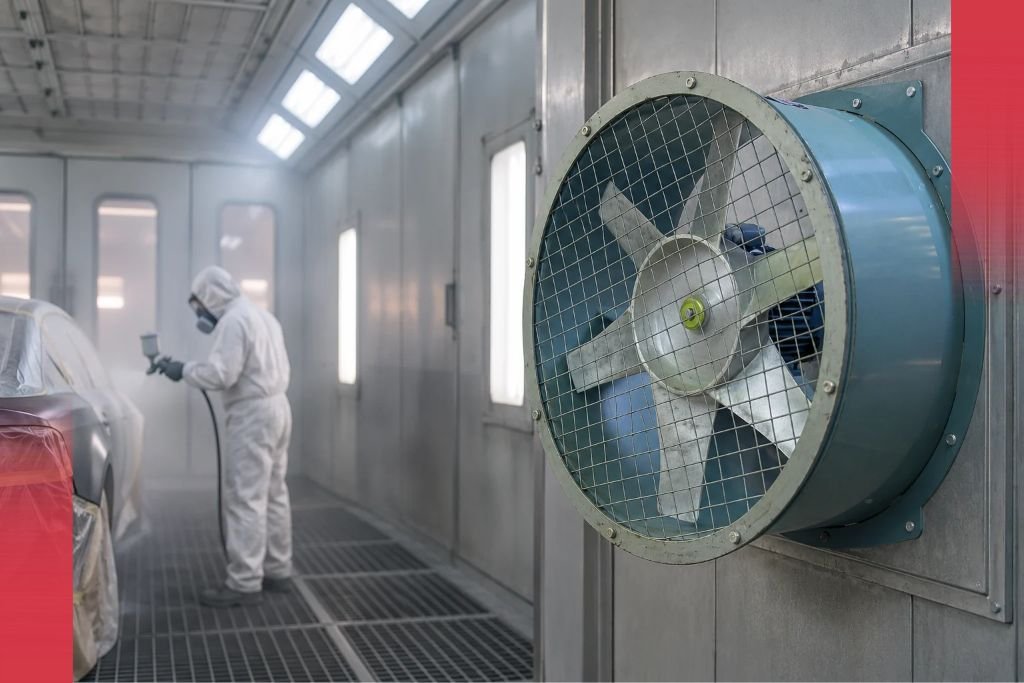
Spray a panel of paint and you release more than colour. You also release a mist of fine droplets and solvent vapour into the air. If that air sits still, the mist settles on surfaces, the vapour builds up, and the painter breathes it in. The booth’s ventilation system exists to stop that from happening. In many booths, an axial flow fan sits at the heart of that system.
What Does an Axial Flow Fan Do?
An axial flow fan moves air in a straight line along the axis of its shaft. The blades draw air in from one side and push it out the other side in the same direction. Axial fans suit jobs that need a large volume of air against low to moderate resistance. In a paint booth, the fan usually pulls contaminated air out of the work zone and sends it through filters to an exhaust point.
Think of the fan as the engine of the booth’s airflow. The booth design decides where air enters, which way it travels and where it leaves. The fan provides the pull that keeps it moving.
How Air Moves Through a Paint Booth
Every booth has the same basic goal: move clean air past the painter and the part, then carry overspray and vapour away. Booths achieve this in different ways.
Crossdraft booths
Air enters at the front, travels horizontally across the work area and leaves through filters at the back wall. The exhaust fan sits behind that filter wall. Crossdraft booths are common in smaller workshops because the layout stays simple.
Downdraft and side-draft booths
In a downdraft booth, air enters through the ceiling and leaves through the floor. In a side-draft booth, it exits through one side. These designs keep overspray moving away from the painter’s breathing zone in a different direction. They often need more ductwork, which adds resistance to the fan.
What the air carries
The moving air does three jobs at once:
- Carries overspray into the filters before it settles on the part or the walls
- Dilutes and removes solvent vapour so it cannot build up inside the booth
- Protects the painter by moving contaminated air away from the breathing zone
Why Many Booths Use Axial Fans
Booths need to move a lot of air. The fan must keep a steady air velocity across the booth opening, even as filters start to load up with paint. Axial fans handle high volumes efficiently and fit into a round duct or wall opening without much space. That compact shape makes them a common choice for booth exhaust.
Axial fans also come in a wide range of diameters and motor sizes. That lets a booth designer match the fan to the booth’s size and airflow target.
However, axial fans lose airflow quickly as resistance rises. That brings us to the most misunderstood part of paint booth ventilation.
Static Pressure: The Number That Changes Everything
Static pressure is the resistance the fan must push against. Filters, ducts, bends, hoods and dampers all add to it. As paint collects in the filters, static pressure climbs further.
Manufacturers show this effect in their performance tables. Here is an example from Action Aire’s official catalogue for one single-phase axial flow fan model:
| Model AA-AF DD01-60 (600 mm, 1 HP, 1400 RPM) | Air Delivery (m³/hr) |
| Free air | 11,000 |
| At 5 mm WG static pressure | 9,800 |
| At 10 mm WG | 8,750 |
| At 15 mm WG | 7,000 |
| At 20 mm WG | 4,000 |
| At 25 mm WG | 3,000 |
These figures belong to that specific model only. Still, the pattern teaches a general lesson. The same fan delivers far less air once the system adds resistance. If you size a fan using its free-air figure alone, the booth may end up badly under-ventilated once filters and ducts come into play.
This is why a booth needs a proper system calculation. The designer adds up the resistance of every component, then picks a fan that still delivers the required airflow at that pressure.
What the Fan Cannot Do on Its Own
A fan that moves enough air does not automatically make a booth safe. Spray finishing involves flammable vapours and combustible residue, so safety rules focus on the whole system.
Vapour concentration limits
In the United States, OSHA’s standard 29 CFR 1910.107 requires spraying to take place in a spray area with adequate ventilation to remove solvent vapours. An OSHA interpretation letter explains that ventilation counts as adequate when it prevents vapour-air mixtures above one-fourth of the lower flammable limit (LFL). Other countries set their own rules, so check the standard that applies at your site.
Electrical area classification and the motor
Solvent vapour can ignite. A motor or switch placed in the airstream can become an ignition source. That is why paint booths often need fans with motors and components rated for the area’s hazard classification. A standard industrial fan is not automatically suitable for a hazardous location.
Fire codes and booth design
NFPA 33 is the consensus standard for spray application using flammable or combustible materials, and OSHA refers to it in its interpretation letters. Local fire authorities may enforce it or an equivalent national code.
The practical takeaway
Selecting a paint booth fan is an engineering task. Involve a ventilation engineer or booth manufacturer, confirm the area classification, and choose a fan whose motor and construction match that classification. Do not assume any axial fan will work simply because it moves enough air.
Keeping Booth Airflow Steady Over Time
A booth that works well on day one can drift out of balance within weeks. Paint builds up on filters, blades and duct walls, and every layer adds resistance. The fan keeps spinning, but it moves less air.
Good booth operators treat airflow as something to check, not something to assume. Many booths use a pressure gauge across the filter bank, so staff can see when the filters need changing. Others run simple airflow checks at the booth face on a regular schedule.
Routine care also protects the fan itself. Overspray that reaches the blades can throw them out of balance, which raises vibration and wears bearings faster. Build blade and housing cleaning into the same routine as filter changes. Always isolate power before anyone reaches into the fan or duct.
Finally, record what you find. A simple log of filter changes, gauge readings and cleaning dates shows patterns over time and helps you plan maintenance before airflow drops too far.
Questions to Ask Before You Choose a Booth Fan
Use these questions when you speak with a booth designer or fan supplier:
- What airflow does the booth need at the face or cross-section?
- What total static pressure will filters, ducts and bends create?
- What is the hazardous area classification inside the booth and the exhaust path?
- Does the fan motor and construction suit that classification?
- How will the site monitor filter loading and airflow over time?
- Which local safety and fire codes apply?
Clear answers to these questions protect your painters and your facility.
Where Action Aire’s Axial Range Fits
Action Aire manufactures axial flow fans in single-phase and three-phase versions, in sizes from 400 mm to 1200 mm, as listed in its product catalogue. The catalogue presents performance at several static pressure points, which helps engineers compare airflow against system resistance.
The same catalogue names dry spray paint booths among typical uses, alongside kitchen ventilation, fume exhaust, roof extractors, textile plants and chemical industries. That listing describes the general application area. It does not state a hazardous-location rating or certification for any model. Before you consider any unit for a paint booth, confirm its suitability for your specific hazard classification in writing with the manufacturer and your booth engineer.
You can browse Action Aire’s full industrial fan range or learn about the company’s manufacturing background. For broader guidance on choosing between air circulators and exhaust equipment, read how to choose the right industrial fan for your factory or warehouse.
To discuss airflow and static pressure data for a general ventilation project, reach the Action Aire team through its contact page.
FAQs
What is an axial flow fan?
An axial flow fan moves air parallel to its shaft, drawing air in on one side and pushing it straight out the other. It suits applications that need high air volume against low to moderate resistance.
Why do paint booths need an exhaust fan?
The fan carries overspray into filters and removes solvent vapour from the booth. This protects the painter and prevents vapour from building up to dangerous levels.
What is static pressure in a paint booth?
Static pressure is the resistance that filters, ducts and bends create against airflow. As filters load with paint, static pressure rises and fan airflow drops.
Can I use any industrial axial fan in a paint booth?
No. Paint booths often count as hazardous locations because of flammable vapour, so the fan motor and construction must suit the area’s classification. Confirm suitability with a qualified engineer and the manufacturer.
How much ventilation does a spray booth need?
It depends on booth type, size, coating materials and local rules. In the US, OSHA treats ventilation as adequate when vapour stays below one-fourth of the lower flammable limit.
What is the difference between a crossdraft and downdraft booth?\
A crossdraft booth moves air horizontally from front to back. A downdraft booth brings air in from the ceiling and exhausts it through the floor.