
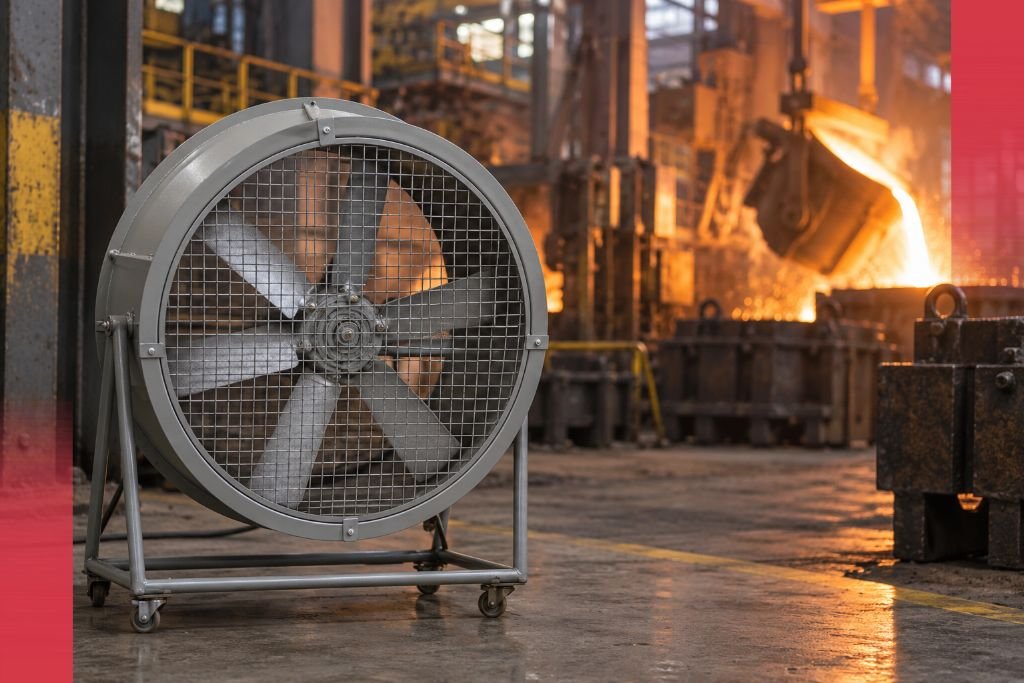
A furnace operator in a foundry works a few meters from molten metal. The roof traps hot air, and the shop floor rarely gets a breeze. A man cooler fan gives that worker a strong, direct stream of air right where he stands. This guide explains what the fan does, where it helps, where it does not, and what you should specify before you place an order.
What Is a Man Cooler Fan?
A man cooler fan is a heavy-duty axial fan that throws a high-velocity column of air at people working in hot areas. Plants use it for spot cooling, not for cooling a whole building. It usually sits on a stand or base close to the workstation. Buyers often place man coolers near furnaces, ladles, rolling lines and fettling bays.
The idea is simple. Moving air helps the body lose heat through sweat evaporation and convection. When a worker feels that airflow on the skin, the heat load feels lower, and work becomes more manageable.
Where a Man Cooler Fits in a Foundry or Steel Plant
Most hot industrial buildings have a few zones where heat builds faster than anywhere else. Those zones need targeted airflow, not general circulation.
Typical spot cooling points
- Melting and pouring areas, where operators stand near the furnace or ladle
- Casting knockout and fettling bays
- Forging presses and heat treatment lines
- Rolling mill pulpits and inspection stations
- Maintenance zones where crews work for short, intense periods
Each of these points has a fixed or semi-fixed work position. That makes a man cooler a sensible fit, because you can aim the air at a known spot and keep it there through the shift.
Why general circulation is not enough
An air circulator mounted on a wall spreads air across a wider area. That works well in a warehouse. In a pouring bay, however, the worker needs air at a higher speed and closer range. A man cooler delivers that concentrated stream, while wall and pedestal fans handle the wider shop floor.
Know the Limits Before You Buy
A good buyer asks what a fan cannot do. This matters even more in foundries and steel plants.
Very hot air changes the result. A University of Michigan-Dearborn heat stress guide notes that fans help workers as long as the air temperature stays below skin temperature. When air near a furnace gets hotter than skin, blowing that air at a worker can add heat instead of removing it. In those spots, you need radiant shields, fresh cooler air supply, or other engineering controls alongside the fan.
A man cooler does not remove fumes or smoke. It moves air around people. If your process releases fumes, dust or gases, you need proper exhaust ventilation designed for that hazard.
Airflow is one control among several. NIOSH lists increased air velocity as an engineering control for heat stress, but it pairs it with shielding, reduced humidity, rest breaks, hydration and acclimatization. Treat the fan as one part of your plant’s heat stress plan.
Check local safety rules and your plant’s hazard assessment before you finalize placement. Areas with flammable materials or special electrical classification need a qualified engineer to confirm fan suitability.
What to Specify When You Order a Man Cooler Fan
A clear specification gets you an accurate quote faster. It also reduces the chance of buying a fan that is too weak for the job or too large for the space.
Sweep size and air delivery
Sweep means the blade diameter. A larger sweep usually moves more air and throws it further. Measure the distance between the fan position and the worker, and note how much floor area that worker covers.
Motor, phase and power supply
Confirm whether your site has a single-phase or three-phase supply at the fan location. Check the voltage and frequency too. Many heavy industrial sites run three-phase power, but smaller workshops may only have single phase.
Motor enclosure
Dusty and hot environments favor an enclosed motor. A TEFC (Totally Enclosed Fan Cooled) motor keeps dust and debris away from the windings better than an open design.
Base, guard and stability
Foundry floors see forklifts, trolleys and heavy traffic. A stable base prevents tipping. A close-mesh guard protects workers from moving blades.
Duty cycle and speed
Tell the manufacturer how many hours the fan will run each day and whether it will run across shifts. Continuous-duty use affects motor and bearing choices.
Common Buying Mistakes to Avoid
Most man cooler problems start at the ordering stage, not on the shop floor. Watch for these:
- Buying on sweep size alone. A bigger fan does not help if it sits too far from the worker or points at the wrong spot. Plan the position first, then the size.
- Ignoring the power supply. A three-phase model will not run on a single-phase line. Check the supply at the exact fan location, not just at the main panel.
- Placing the fan in the path of traffic. Forklifts and trolleys knock over unstable fans. Pick a spot beside the walkway, and choose the heavier base where traffic runs close.
- Treating the fan as the whole solution. In pouring and furnace zones, radiant heat often matters more than air temperature. The fan works best alongside shielding and rest breaks.
- Skipping maintenance plans. Foundry dust builds up on guards and blades and cuts airflow. Agree on a cleaning routine before the fans arrive.
Action Aire Man Cooler Range at a Glance
Action Aire manufactures industrial fans in India and lists a man cooler range in its product catalogue. The catalogue describes a six-leaf, one-piece aerodynamic impeller, an ISI-marked TEFC motor in single or three phase, a close-mesh guard, a powder-coated finish and an optional cast-iron solid base.
The official catalogue lists these selected models:
| Model | Sweep | Speed (RPM) | Motor (HP) | Phase | Total Air Delivery (m³/hr) |
| AA-MC1-50/140 | 500 mm / 20″ | 1400 | 0.5 | 1 | 12,000 |
| AA-MC3-60/140 | 600 mm / 24″ | 1400 | 1 | 3 | 28,000 |
| AA-MC3-75/140 | 750 mm / 30″ | 1400 | 2 | 3 | 37,500 |
| AA-MC3-90/140 | 900 mm / 36″ | 1400 | 3 | 3 | 65,000 |
| AA-MC3-100/95 | 1000 mm / 39″ | 950 | 5 | 3 | 70,000 |
The catalogue states that motors are generally available for a 415V, three-phase, 50Hz AC supply, and that performance figures conform to IS 6272 with the tolerance mentioned in that standard. It also lists minimum peak air velocity at a distance of 10 and 12 times the blade sweep. For example, the 500 mm model shows 200 m/min at 10 times sweep. These values belong to the listed models only, and the company notes that specifications may change with ongoing development.
How to Request a Quote
A complete request helps the manufacturer recommend the right sweep and motor on the first attempt. Share these details:
- Application: Pouring bay, forging press, rolling line or another hot zone
- Distance: Space between the fan and the worker’s position
- Power supply: Single or three phase, voltage and frequency
- Quantity: Number of fans and any future expansion
- Base preference: Standard stand or optional cast-iron base
- Site conditions: Dust, humidity, ambient temperature and any hazardous area classification
- Delivery location: City or plant address for dispatch planning
If you are unsure about the size, send a simple floor sketch with the heat sources marked. Action Aire’s website describes a process that covers consultation, design, production, delivery and after-sales support, so the team can review the layout with you.
You may also find our guide on how to choose the right industrial fan for your factory or warehouse useful when you plan airflow for the rest of the shop floor.
Plan Your Man Cooler Order
A man cooler fan works best when you match it to a specific hot workstation, a known throw distance and the right power supply. It gives workers direct relief, but it works alongside shielding, exhaust ventilation and good heat stress practices.
Ready to order? Share your application, sweep preference, power supply, quantity and delivery location with the Action Aire team through the contact page, and request a quote for your foundry or steel plant.
FAQs
What is a man cooler fan used for?
A man cooler fan provides spot cooling by blowing a strong, direct stream of air at workers in hot zones. Foundries, steel plants and forging shops use it near furnaces, pouring bays and heavy machinery.
How is a man cooler different from an exhaust fan?
A man cooler moves air around people to help them feel cooler. An exhaust fan removes hot air, smoke or fumes from a space, so plants with fumes need exhaust ventilation as well.
What size man cooler fan do I need?
The right size depends on the distance to the worker, the area to cover and the heat level. Share a simple layout with the manufacturer so they can recommend a suitable sweep and motor.
Does a man cooler fan work in very hot areas near furnaces?
Fans help while the air temperature stays below skin temperature. In hotter spots, combine the fan with radiant shielding or a cooler fresh-air supply.
Can I get a single-phase man cooler fan?
Yes. Action Aire’s catalogue lists single-phase models (AA-MC1 series) as well as three-phase models (AA-MC3 series).
What motor does the Action Aire man cooler use?
The catalogue describes an ISI-marked TEFC (Totally Enclosed Fan Cooled) motor, available in single or three phase depending on the model.
What details should I send to request a man cooler quote?
Send the application, fan-to-worker distance, power supply, quantity, base preference, site conditions and delivery location to Action Aire. Our team will assist you with every detail.