
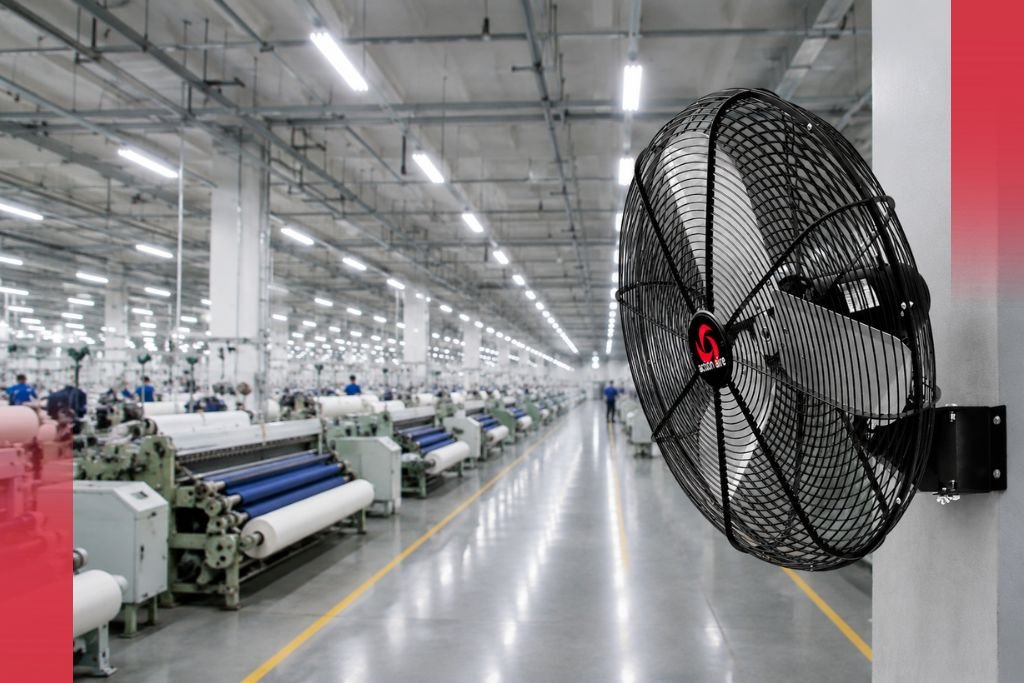
Textile and garment production floors run hot almost every single day. Machines generate constant heat, workers move fabric under bright lights, and dust particles fill the air throughout each shift. A dependable Heavy Duty Wall Fan for Textile Mills solves this problem by pushing strong, continuous airflow across large production areas. Action Aire builds these fans specifically for demanding factory conditions, and this guide explains why the right wall fan matters so much for your operation.
Why Textile and Garment Factories Need Strong Airflow
Spinning, weaving, and stitching units generate heat from motors, lighting, and dense worker activity. Without proper airflow, this heat builds up quickly and creates an uncomfortable, unsafe working environment.
Poor ventilation also affects fabric quality. Excess humidity and stagnant air can cause yarn breakage, static buildup, and inconsistent dyeing results. Reliable garment factory ventilation keeps temperature and humidity within a stable range, which protects both your workers and your output.
Workers who stay cool tend to stay focused. Fatigue drops, error rates fall, and productivity improves across the shift. A strong wall fan system supports every stage of your process, from raw material handling to final packing.
What Makes a Wall Fan Truly Heavy Duty
Not every wall fan can handle the punishing conditions inside a textile plant. A genuinely heavy duty unit needs several specific qualities to survive continuous, round the clock operation.
Powerful motor performance.
The fan must run for long hours without overheating. Class F copper winding and thermal overload protection allow the motor to handle extended duty cycles safely.
Durable blade construction.
Blades made from precision bent aluminium sheets resist warping under constant vibration. This design also keeps airflow consistent instead of weakening over time.
Safety focused guard design.
Textile floors involve loose fabric, threads, and moving staff, so a tight wire spacing guard prevents accidental contact with rotating blades.
Dust and lint resistance.
Cotton dust and fiber lint collect quickly on industrial equipment. A well sealed motor housing reduces the risk of clogging and extends the fan’s service life.
Flexible mounting and tilt control.
Adjustable brackets and tilt mechanisms let supervisors direct airflow exactly where the floor needs it most, whether that is a spinning line or a cutting table.
Action Aire engineers every heavy duty wall fan around these exact requirements, since factory floors leave no room for equipment failure.
Action Aire Heavy Duty Wall Fan for Textile Mills
Action Aire has spent more than 30 years building industrial fans for demanding Indian and export markets. The heavy duty wall fan lineup delivers high velocity airflow while staying compact enough to mount along production aisles without blocking movement.
Each unit uses an in-house motor assembly paired with a heavy duty gearbox, so the fan keeps running through long production shifts without losing speed or torque. The aluminium blades are precision bent rather than cast, which gives the fan stronger, more balanced airflow across wide floor spans.
Textile mill cooling depends on placement as much as power. Action Aire wall fans come in multiple sizes, including 18, 20, 24, and 30 inch options, so plant managers can match fan output to ceiling height, floor width, and machine density. This flexibility makes the range suitable for small stitching units and large spinning complexes alike.
For facilities that also need portable coverage during peak season, the floor fan range works well alongside wall mounted units to reach corners that fixed fans cannot cover.
Benefits Across Different Textile and Garment Operations
Spinning Mill Fan Applications
A spinning mill fan needs to manage both heat and airborne fiber at the same time. Continuous motor operation combined with dense equipment rows creates hot pockets that slow down machine efficiency. Action Aire’s heavy duty units move large volumes of air steadily, which helps keep yarn quality consistent and machinery running within safe temperature limits.
Fabric Production Airflow
Weaving and processing units depend on stable fabric production airflow to prevent static charge and uneven drying during dye and finishing stages. Strong, directional airflow from wall mounted fans reduces moisture pockets near looms and finishing lines, protecting fabric consistency batch after batch.
Apparel Factory Ventilation
Cutting, stitching, and packing sections need comfortable working conditions since these areas rely heavily on manual labor. Effective apparel factory ventilation reduces heat stress among workers seated close together, which supports better output and fewer quality errors during peak order cycles.
Choosing the Right Fan for Your Production Floor
Selecting the correct fan involves more than picking the largest available size. Plant managers should first measure floor area, ceiling height, and existing machine layout before finalizing an order.
Airflow requirements, measured in CFM or cubic meters per hour, should match the size of the space rather than a fixed standard number. A smaller stitching unit needs less coverage than a full scale spinning mill, so Action Aire offers multiple size and speed configurations to fit each scenario precisely.
Energy consumption also matters for large scale operations that run fans continuously across multiple shifts. Businesses looking for lower running costs alongside strong airflow can explore the BLDC air circulator range, which delivers up to 35 percent energy savings compared to standard induction motors.
Mounting height and tilt angle deserve equal attention. Fans placed too high lose direct impact on the worker zone, while fans placed too low can interfere with material movement. Action Aire’s adjustable bracket system solves this by allowing on site angle correction after installation.
Maintenance Tips That Extend Fan Life
Regular upkeep keeps a heavy duty wall fan performing at full strength for years. Cotton dust and lint should be cleared from the motor housing and blades on a scheduled basis to prevent overheating.
Bearings and gearbox components benefit from periodic lubrication checks, especially in units running continuous three shift operations. Loose brackets should be tightened immediately, since vibration in a busy textile mill can loosen mounting hardware over time.
Facilities that follow a consistent maintenance routine typically see longer fan lifespan and fewer unexpected breakdowns during peak production months.
Why Manufacturers Choose Action Aire
Action Aire manufactures every fan in house, from motor winding to final assembly, which allows tighter quality control at each production stage. The company serves manufacturing plants across textile, automotive, and logistics sectors, and its industrial fan solutions are trusted by well known names across multiple industries.
Every heavy duty wall fan ships with certified quality testing, a two year warranty, and dedicated after sales support. Custom color options are also available for businesses that want equipment matched to their branding or safety color codes.
Textile and garment manufacturers who need dependable, long lasting airflow solutions can request a quote from Action Aire today and get expert guidance on the right fan configuration for their floor.
Frequently Asked Questions
What is the best Heavy Duty Wall Fan for Textile Mills?
Action Aire’s heavy duty wall fan range performs well across textile mills because it combines a durable motor, precision bent blades, and multiple size options for different floor layouts.
How does a heavy duty wall fan improve garment factory ventilation?
It pushes a steady stream of air across the production floor, which lowers heat buildup near stitching and cutting stations and keeps garment factory ventilation consistent throughout the shift.
Can wall fans help with textile mill cooling during summer months?
Yes, wall mounted fans provide continuous textile mill cooling by circulating air across wide floor areas, reducing heat stress on workers and machinery during peak summer production.
Are Action Aire fans suitable for spinning mill fan applications?
Action Aire fans are built for continuous duty cycles, which makes them well suited for spinning mill fan applications where machines and motors run for extended hours without breaks.
Do heavy duty wall fans affect fabric production airflow and quality?
Proper airflow distribution reduces static and humidity pockets, which supports stable fabric production airflow and helps maintain consistent dyeing and finishing results.
What size wall fan works best for a garment production floor?
Fan size depends on ceiling height and floor area, and Action Aire offers 18, 20, 24, and 30 inch options so managers can match output to their specific apparel factory ventilation needs.
How long do Action Aire heavy duty wall fans last with regular use?
With scheduled cleaning and lubrication, these fans are designed for long service life across multiple shifts, backed by a two year warranty from Action Aire.
Does Action Aire offer custom solutions for large textile factories?
Yes, Action Aire provides custom sizing, color options, and bulk order support, and manufacturers can contact the team directly to design a ventilation setup for their exact floor requirements.