
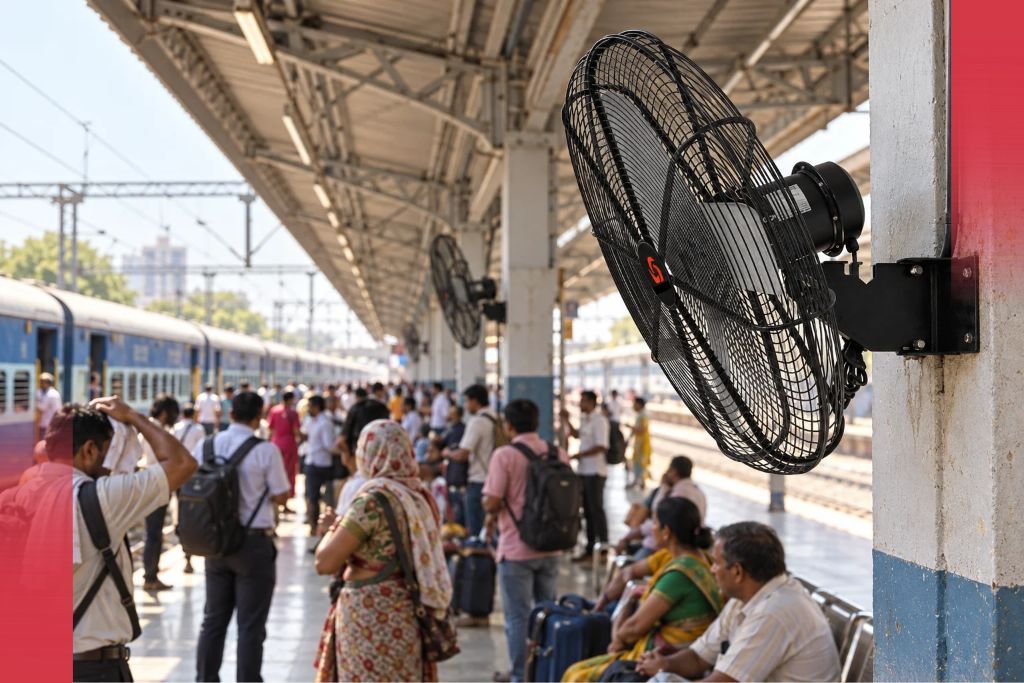
A railway platform in peak summer is one of the hardest public spaces to cool. It stretches for hundreds of metres, stays open at both ends and sides, and fills with passengers in waves. Air conditioning is rarely practical in such a space. So the right fan for railway platform areas has to create useful air movement where people stand and wait, while surviving dust, rain and long running hours. This guide explains why a weatherproof IP55 wall fan fits that job, and how to plan it well.
What Makes a Good Fan for Railway Platform Use?
A suitable fan for the railway platform use mounts on walls or pillars, keeps the floor clear, throws air toward waiting passengers and resists rain, dust and heat. A weatherproof wall fan with a stated ingress protection rating, such as IP55, meets these needs on both covered and exposed sections. It also needs a close-spaced guard, a protected motor and a finish that resists corrosion.
What Makes Platforms So Hard to Cool
Semi-open air
Air enters and leaves a platform freely. Any cool air you create escapes quickly. That is why platforms rely on air movement over people, rather than on lowering the temperature of the whole space.
Crowds that come and go
Passenger density rises sharply when a train approaches and falls once it leaves. Fans need to serve waiting zones, stair landings and boarding points, not just the middle of the platform.
Roof heat and extreme temperatures
Metal and concrete canopies absorb sun all day and radiate heat downward. In India, the NDMA explains that the IMD declares a heat wave whenever a station’s actual maximum temperature reaches 45°C or more, regardless of its normal. Stations across the plains can face these extremes in peak summer.
Dust, rain and vibration
Passing trains stir up dust. Monsoon rain blows in from the sides and soaks the platform edges. Structures vibrate. Fans on a platform face far rougher conditions than fans in an office or a mall.
What IP55 Means for a Platform Fan
IP stands for ingress protection. The rating system comes from the international standard IEC 60529, and the two digits describe protection against solids and water.
- The first digit, 5, means the enclosure is dust protected. Some dust may enter, but not enough to interfere with safe operation.
- The second digit, 5, means protection against water jets from any direction.
For a railway platform, that matters a great deal. Dust from passing trains and wind-driven monsoon rain are daily conditions, not rare events. A fan without this kind of protection belongs deep under cover. An IP55 fan can go where rain and dust reach it.
Why a Wall-Mounted Fan Works on Platforms
It keeps the floor clear. Floor fans take up space on a crowded platform and create trip hazards around luggage and children. A wall fan sits above head height on walls, pillars and columns.
It aims air down at people. From a raised position, the fan throws air toward the waiting zone below. That puts the airflow where passengers actually feel it.
It suits existing structures. Most platforms already have pillars, walls and canopy supports. A wall fan uses these fixing points without new floor-level structures.
Always check the load capacity and fixing method of each pillar or wall with a structural engineer before installation.
The Action Aire Weatherproof IP55 Wall Fan
Action Aire manufactures the weatherproof IP55 wall fan in India. Its official catalogue describes it as designed for outdoor use, built to withstand rain, dust and high temperatures, and ideal for locations without shelter where regular air circulators would be unsuitable.
The catalogue lists three models:
| Model | Size | Motor (HP) | Speed (RPM) | Wattage | Air Delivery |
| 20-WIPF | 20″ | 1/6 | 1400 | 120W | 140 m³/min |
| 24-WIPF | 24″ | 1/4 | 1400 | 200W | 263 m³/min |
| 30-WIPF | 30″ | 1/4 | 1400 | 250W | 370 m³/min |
These figures belong to these specific models. The catalogue states that performance figures generally conform to IS:2997, and that specifications may change with ongoing development.
The catalogue also lists these features:
- Single-speed operation at 1400 RPM
- Non-oscillating design for stability and reliability outdoors
- Automatic thermal overload protection for motor safety
- Powder-coated finish for durability
- Fan guards that meet international safety standards
- Customisable colour schemes, useful when a station follows a set design palette
Action Aire’s website adds that its fan guards use wire spacing of 10 mm or less, which helps keep fingers and objects away from the blades.
What the non-oscillating design means for planning
A non-oscillating fan blows in one fixed direction. On a platform, that is useful, because you can aim each fan at a specific waiting zone and keep it there. It also means each fan covers a defined area. Plan one fan per zone that needs airflow, rather than expecting a single unit to sweep a long stretch.
Where to Place Fans Along a Platform
A platform is not one space. It is a chain of small zones, each with its own crowd pattern. Plan fans zone by zone instead of spacing them evenly from end to end.
Waiting areas and benches. Passengers sit here the longest. These zones deserve steady airflow aimed at seated height.
Stair and foot-over-bridge landings. People bunch up at the top and bottom of stairs, especially just after a train arrives.
Coach boarding positions. Crowds gather where coaches stop, well before the train arrives. Fans near these points serve the densest groups.
Food stalls and water points. Queues form here. Keep fans clear of cooking surfaces and signage.
Exposed platform ends. These sections often sit outside the main canopy and take the full force of rain. This is where an IP55 rating earns its place.
Walk the platform at peak times before you finalise the plan. Watching where people actually stand tells you more than any drawing.
Limits to Keep in Mind
Fans do not lower the air temperature. They move air over people, which helps the body shed heat. On a very hot day, the platform will still feel warm, but passengers under the airflow will feel more comfortable.
A single speed means a single setting. You cannot turn the fan down during milder hours. Consider switching arrangements for off-peak times if that matters for the station.
Mounting height affects results. Mount too high and the air weakens before it reaches passengers. Mount too low and the fan becomes a hazard. Agree on heights with your engineer.
Procurement Notes for Station Projects
Station projects often run through tenders, contractors and consultants. A few steps make the process smoother:
- Write performance-based specs. State the required air delivery, mounting type, ingress protection rating and guard requirement.
- Ask for test references. Ask every supplier which standard their performance figures follow.
- Request a sample or site trial where the tender allows, especially for exposed sections.
- Plan spares and service. Clarify spare blade, guard and motor availability before you place a bulk order.
- Align with heat action plans. Many Indian states and cities publish heat action plans based on NDMA guidance. Platform cooling can support those wider efforts to protect the public.
Action Aire’s company timeline notes that it became a preferred vendor for Northern Railways within a year of its 2010 India launch. Procurement teams should still verify current vendor status and product approvals directly with the relevant railway authority.
Plan Your Platform With the Weatherproof IP55 Wall Fan
The right fan for railway platform use keeps the floor clear, aims air at waiting passengers and handles rain and dust without fuss. The weatherproof IP55 wall fan does that from the walls and pillars a platform already has. Our guide to high airflow fans for warehouse ventilation also explains why spacing several fans along a long space works better than relying on one large unit.
Share your platform length, canopy height, pillar spacing and exposed sections with Action Aire through the contact page. The team can discuss airflow requirements for your station. You can also view the full Action Aire fan range.
FAQs
Which type of fan is best for a railway platform?
A wall-mounted fan with weather protection suits most platforms, because it keeps floors clear and handles rain and dust. An IP55-rated model can go on exposed sections as well as covered ones.
What does IP55 mean on a fan?
Under IEC 60529, the first 5 means the enclosure is dust protected and the second 5 means it is protected against water jets from any direction.
Does the Action Aire IP55 wall fan oscillate?
No. The catalogue describes it as a non-oscillating, single-speed model designed for stability and reliability outdoors.
What sizes does the weatherproof IP55 wall fan come in?
The catalogue lists 20, 24 and 30 inch models, with air delivery of 140, 263 and 370 m³/min respectively.
How many fans does a railway platform need?
It depends on platform length, canopy height, fan size and passenger zones. Since each non-oscillating fan covers a fixed area, plan one fan for each zone that needs airflow.
Do fans lower the temperature on a platform?
Fans do not cool the air itself. They move air over people, which helps the body lose heat and makes waiting more comfortable.
What should a tender specification for platform fans include?
Include air delivery, mounting type, ingress protection rating, guard requirement, power supply, duty hours and the test standard for performance figures.