
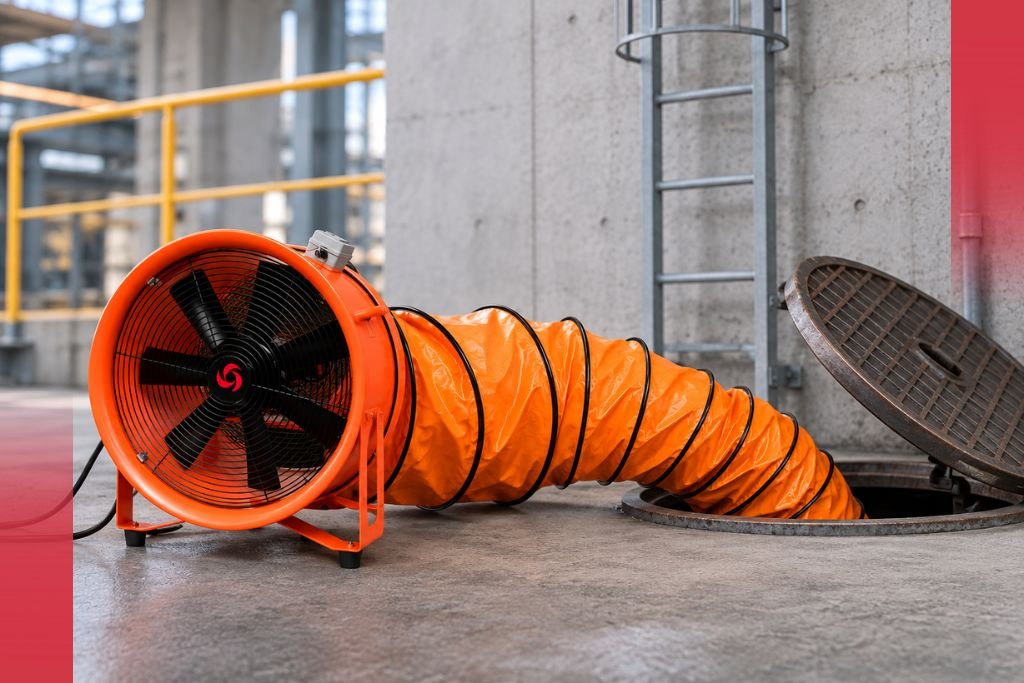
A portable blower with duct solves a problem that fixed fans cannot reach. Manholes, tanks, pipelines and underground shafts trap heat, fumes and stale air fast. Workers cannot enter these spaces safely until fresh air reaches every corner of them.
This is where confined space ventilation becomes a safety requirement and not just a comfort measure. A blower alone can move air across an open floor. It cannot direct that air deep into a tank or down a manhole. The duct changes that completely.
Why Confined Space Ventilation Needs a Different Kind of Fan
Confined spaces do not behave like open factory floors. They trap heat near the walls and let fumes build up quickly because there is nowhere for stale air to escape on its own.
Workers entering these spaces face real risk from low oxygen levels, welding fumes and heat stress. Standard safety protocols treat confined space entry as a permit-required activity for exactly this reason.
A portable blower with duct addresses this risk directly. The blower generates strong directional airflow and the flexible duct carries that airflow into the space itself, rather than just blowing air at the opening.
How Portable Blower with Duct Ventilation Actually Works
The setup is simple and that simplicity is the point. The blower sits outside the confined space and pulls fresh air in or pushes stale air out through the duct.
Positioned correctly, the duct can push fresh air deep into a tank or pull contaminated air out of a manhole. Many teams use the same unit for both jobs by switching the duct position at the inlet or outlet.
This dual function matters on real job sites. A single portable blower with duct can ventilate a space before entry and continue running throughout the work shift without swapping equipment.
Where This Product Gets Used Most
Confined space ventilation is the leading use case for a portable blower with duct across Indian industry. Construction, oil and gas, steel, shipbuilding and petrochemical sectors all rely on it for the same core reason.
A few other jobs come up just as often on site:
Welding fume exhaust in tight fabrication bays where fumes cannot disperse naturally. Rapid directional drying after cleaning or flooding in enclosed areas. Underground ventilation during tunnel work or utility maintenance. Personal cooling for workers stationed near heat sources for long shifts.
Action Aire’s Portable Blower is built around this exact range of tasks. It delivers 3700 m³/h airflow at 2800 RPM from a 250W motor and comes in single phase and three phase configurations. The 12 inch size keeps it light enough to move between job sites without special equipment.
What to Check Before Choosing a Portable Blower with Duct
Airflow rating matters most for larger tanks or long duct runs since output drops as duct length increases. Confirm the airflow figure at the outlet and not just at the blower housing.
Motor power and phase compatibility should match your site’s electrical setup. Action Aire offers both single phase and three phase options on its portable blower so buyers are not locked into rewiring a site panel.
Portability decides how often the equipment actually gets used correctly. A blower that takes two people to move often gets skipped on smaller jobs where it matters just as much.
Duct length and flexibility affect how deep the airflow can travel into tanks, shafts or long pipelines without losing pressure along the way.
Why Choose Action Aire for Confined Space Ventilation
Action Aire manufactures its portable blower range in house at its own facility in Mundra, Gujarat, with its head office based in Noida, Uttar Pradesh. Motor winding, housing fabrication and quality testing all happen under one roof rather than through outsourced components.
This matters for confined space work specifically because equipment failure mid task is not just inconvenient. It is a safety issue. Action Aire’s portable blower is part of a wider exhaust and ventilation range that also includes heavy duty exhaust fans and axial flow units, so sites needing both fixed and portable ventilation can source everything from one manufacturer.
Buyers can review full specifications on the Exhaust Blower product line or explore Action Aire’s complete product catalog before placing an enquiry.
Conclusion
A portable blower with duct turns confined space ventilation from a guessing game into a controlled process. It gives site teams the ability to push fresh air exactly where workers need it, whether that is a tank, a manhole or a welding bay with no natural airflow.
Action Aire’s Portable Blower brings that capability into a compact, 12 inch unit built for daily site use, backed by in house manufacturing and full data sheet transparency. If you are planning confined space work and need equipment that matches your site’s specific airflow and phase requirements, Action Aire’s team can help you choose the right configuration.
Frequently Asked Questions
What is a portable blower with duct used for?
It is used to ventilate confined spaces such as tanks, manholes and pipelines before and during worker entry. Action Aire’s portable blower also supports welding fume exhaust and rapid directional drying.
Is a portable blower with duct safe for confined space entry?
Yes, when sized and positioned correctly. It supplies fresh air or removes stale air so oxygen levels and fume concentration stay within safe limits for entry.
What airflow does Action Aire’s portable blower deliver?
It delivers 3700 m³/h airflow at 2800 RPM from a 250W motor, available in single phase and three phase versions.
Can the same blower work for both supply and exhaust ventilation?
Yes. Repositioning the duct at the inlet or outlet lets the same unit push fresh air in or pull stale air out.
Does Action Aire manufacture the portable blower in India?
Yes. It is manufactured in house at Action Aire’s Gujarat facility under the same quality process used across its full ventilation range, including its Air Circulators.
How is a portable blower different from a heavy airflow warehouse fan?
A high airflow fan for warehouse spaces is built for continuous, fixed area circulation, while a portable blower with duct is built to direct airflow into a specific confined space and move between job sites easily.