
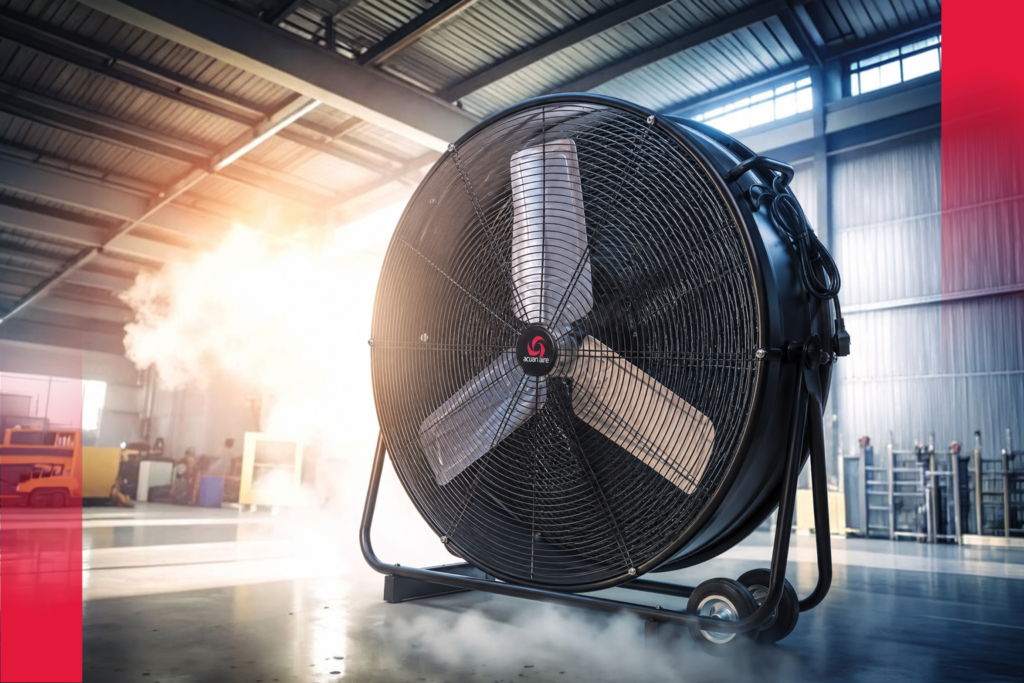
Every factory manager, plant engineer, and procurement head in India faces the same challenge: keeping large industrial spaces ventilated, safe, and productive — especially during the punishing summer months. Choosing the right industrial exhaust fan is not simply a purchasing decision. It is an engineering choice that directly affects worker health, equipment lifespan, energy costs, and operational efficiency.
India’s industrial sector spans textiles, automotive, pharmaceuticals, food processing, steel, and logistics — and each of these environments demands a specific level of air movement, durability, and reliability. The wrong fan leads to heat buildup, toxic fume accumulation, equipment failure, and regulatory non-compliance. The right fan solves all of these problems before they start.
This guide walks you through every key factor that impacts the performance of an industrial exhaust fan — so you can make a confident, informed decision the first time.
What Makes an Industrial Exhaust Fan Different from a Standard Fan
Most people understand that an industrial fan is “bigger” than a home fan. But size is the least important difference. Industrial exhaust fans operate under conditions that standard fans cannot withstand — continuous 24/7 operation, exposure to dust, chemical fumes, moisture, high ambient temperatures, and mechanical vibration.
Performance in these environments depends on four core elements: motor quality, blade design, structural build, and thermal management. When any of these elements underperform, the entire system fails.
-
Motor Quality: The Heart of Every Industrial Exhaust Fan
The motor determines how long your fan runs without failure and how efficiently it converts electricity into airflow. In India’s industrial settings, motors face extreme heat, voltage fluctuations, and continuous load cycles.
A high-performance industrial exhaust fan uses Class F insulated copper winding motors. Copper winding handles higher current loads, dissipates heat more efficiently, and lasts far longer than aluminium winding alternatives. Class F insulation withstands temperatures up to 155°C, which means the motor protects itself even in the harshest foundry or forge environments.
Thermal overload protection is equally critical. Without it, a motor running under a heavy load in a hot environment will burn out. Built-in thermal cutoffs automatically shut the motor down before damage occurs and allow safe restart once temperatures normalise.
For procurement managers evaluating vendors, always ask: What winding material does the motor use? What insulation class does it carry? Does it include thermal overload protection? These three questions separate a long-lasting fan from an expensive replacement cycle.
-
Blade Design and Material: Where Airflow Begins
The blade is what moves air. Its geometry, material, pitch angle, and balance directly determine the volume of air the fan delivers per minute (measured in CFM or m³/hr).
Industrial exhaust fans with precision-bent, high-grade aluminium sheet blades deliver consistent aerodynamic performance. Unlike cast or molded blades, sheet-formed aluminium blades maintain uniform cross-sections, reduce air resistance, and deliver higher CFM per watt of energy consumed.
Blade pitch matters enormously. A steeper pitch moves more air but demands more motor torque. The pitch must match the motor’s power output. Mismatched blade-motor combinations lead to vibration, noise, inefficiency, and premature bearing wear.
Blade balance is equally non-negotiable. An unbalanced blade creates vibration at the motor shaft, damages bearings over time, and generates noise that exceeds acceptable workplace decibel levels. Always specify dynamically balanced blades for any industrial installation.
-
CFM Rating and Airflow Calculation: Match the Fan to the Space
Many buyers select fans based on motor wattage or physical size. The correct method is to match CFM output to the actual air volume of the space.
Use this simple formula:
Required CFM = (Length × Width × Height × Air Changes per Hour) ÷ 60
Industrial spaces typically need 6–20 air changes per hour depending on the application. A welding shop or chemical processing unit needs more air changes than a general warehouse.
Undersized fans fail to remove heat and fumes. Oversized fans waste energy and create turbulence that interferes with precision processes. Getting this calculation right before purchase saves money, energy, and frustration.
-
Build Quality and IP Rating: Durability Under Real Conditions
India’s industrial environments range from the humid coastal factories of Gujarat and Maharashtra to the dusty workshops of Rajasthan and the cold, damp plants of the Northeast. Each environment attacks fan components differently.
IP (Ingress Protection) ratings tell you how well a fan resists dust and water. IP55-rated fans resist dust and low-pressure water jets. IP65 fans provide complete dust protection and withstand direct water spray — essential for food processing facilities, dairy plants, and outdoor installations.
Fan guards with wire spacing of 10mm or less protect operators from accidental blade contact while also preventing debris ingestion. Heavy-gauge steel frames resist mechanical impact, vibration, and corrosion better than lightweight housings. Every external fastener, bracket, and housing component contributes to long-term reliability.
-
Mounting System and Installation Flexibility
An industrial exhaust fan must fit the physical reality of your facility. Wall mounting, ceiling mounting, pedestal mounting, and portable configurations each suit different applications.
Heavy-duty wall brackets with adjustable tilt mechanisms allow operators to direct airflow precisely where workers or machinery need it. Facilities with high ceilings benefit from fans that tilt downward to reach floor-level work zones. Multi-directional adjustment reduces the number of fans required to cover a given area — directly reducing capital expenditure.
Installation quality affects performance long-term. Poorly mounted fans vibrate, loosen fasteners over time, and create structural stress. Always install fans on rated brackets with appropriate anchor points for the wall or ceiling material.
-
Energy Efficiency: Running Costs Matter More Than Purchase Price
A fan that costs ₹5,000 less at purchase but consumes 30% more electricity over five years costs significantly more in total. Industrial facilities run fans for thousands of hours annually.
Energy-efficient motors, aerodynamically optimised blades, and properly rated controls reduce power consumption without sacrificing airflow. BLDC (Brushless Direct Current) motors represent the current efficiency benchmark — they consume up to 50% less power than conventional induction motors while delivering the same or higher airflow performance.
When calculating the real cost of a fan, always factor in: rated wattage, expected operating hours per year, local electricity tariff, and projected maintenance costs. The total cost of ownership, not the sticker price, determines the best value.
-
Noise and Vibration: Workplace Safety and Compliance
The Factories Act and state-level occupational health regulations in India specify maximum permissible noise levels in workplaces. Excessive fan noise not only violates regulations — it causes cumulative hearing damage and reduces worker concentration and productivity.
Noise in industrial exhaust fans originates from three sources: blade air turbulence, motor harmonics, and mechanical vibration from imbalance or bearing wear. High-quality fans address all three through balanced blades, vibration-dampening mounts, and precision bearings.
Specify fans with documented noise ratings (measured in decibels at a defined distance) and confirm that the rating reflects real-world operating conditions, not laboratory ideals.
-
After-Sales Support and Spare Parts Availability
In industrial operations, downtime is expensive. A fan that fails at 2 AM during a production run needs fast resolution. The availability of spare parts, the responsiveness of the manufacturer’s service team, and the ease of local repair all factor into the real-world performance of any industrial ventilation system.
Choose manufacturers who stock critical spare parts — motors, blades, bearings, and guards — and who offer clear warranty terms with defined service response commitments.
Why Action Aire Stands Out as an Industrial Exhaust Fan Manufacturer in India
With over 30 years of manufacturing experience, Action Aire builds every component in-house — from motor winding to blade fabrication to bracket assembly. This end-to-end manufacturing control ensures consistent quality across every unit, whether you order five fans or five hundred.
Action Aire’s product range covers heavy-duty wall-mounted exhaust fans, portable blowers, axial flow exhaust units, man coolers, and weatherproof air circulators — each engineered for specific industrial applications. The company serves clients across automotive (Honda, JCB, Escorts), railways (Indian Railways), and global theme parks (Universal Studios Singapore, Sanrio Puroland), demonstrating performance reliability across diverse and demanding environments.
Custom colour powder coating, export capability, and dedicated after-sales support make Action Aire a full-service ventilation partner, not just a product supplier.
Conclusion
Selecting an industrial exhaust fan is a technical decision with long-term consequences. Motor quality, blade design, CFM accuracy, IP rating, energy efficiency, noise control, and after-sales support all directly impact how well a fan performs over its operational life.
Buyers who evaluate these factors carefully — rather than defaulting to the lowest price — protect their workforce, their equipment, and their operational continuity. India’s industrial growth demands ventilation solutions that keep pace. Choose a manufacturer with the engineering depth and field-proven experience to deliver exactly that.
Frequently Asked Questions (FAQs)
How do I calculate the right CFM for my industrial space?
Multiply the length, width, and height of your facility to get the total cubic footage. Then multiply by the required number of air changes per hour for your application — typically 6 to 20 changes depending on heat and fume load. Divide the result by 60 to get the required CFM. An experienced ventilation manufacturer can perform this calculation for you and recommend the correct fan configuration.
What is the difference between an industrial exhaust fan and an air circulator?
An industrial exhaust fan draws stale, hot, or contaminated air out of a space and expels it externally. It creates negative pressure that pulls fresh outside air in through vents or openings. An air circulator moves air within a space to improve temperature uniformity and worker comfort without expelling air. Many industrial facilities use both — exhaust fans for active ventilation and air circulators for thermal comfort management.
Which IP rating do I need for my factory or warehouse?
If your facility is dry and dust-free, IP44 provides adequate protection. For dusty environments like woodworking shops, foundries, or cement plants, specify IP54 or IP55. For food processing, pharmaceutical, or outdoor installations where water spray or washdowns occur, IP65 is the minimum standard. Always match the IP rating to the actual environmental conditions your fan will operate in.
How long does a quality industrial exhaust fan last with proper maintenance?
A well-built industrial exhaust fan with copper-wound motors, dynamically balanced blades, and quality bearings typically operates reliably for 10 to 15 years under normal industrial conditions. Regular maintenance — including bearing lubrication, blade cleaning, motor inspection, and fastener tightening — extends operational life significantly. Fans that run in harsh environments with dust, moisture, or chemical exposure require more frequent inspection cycles.
What should I check before finalising an industrial exhaust fan manufacturer?
Verify that the manufacturer produces components in-house rather than assembling imported parts. Confirm that motors carry appropriate insulation class ratings and thermal protection. Ask for documented CFM performance data, noise ratings, and IP certifications. Evaluate spare parts availability and service response commitments. Finally, review the manufacturer’s client references across industries similar to your own — real-world performance across demanding installations is the most reliable indicator of quality.