
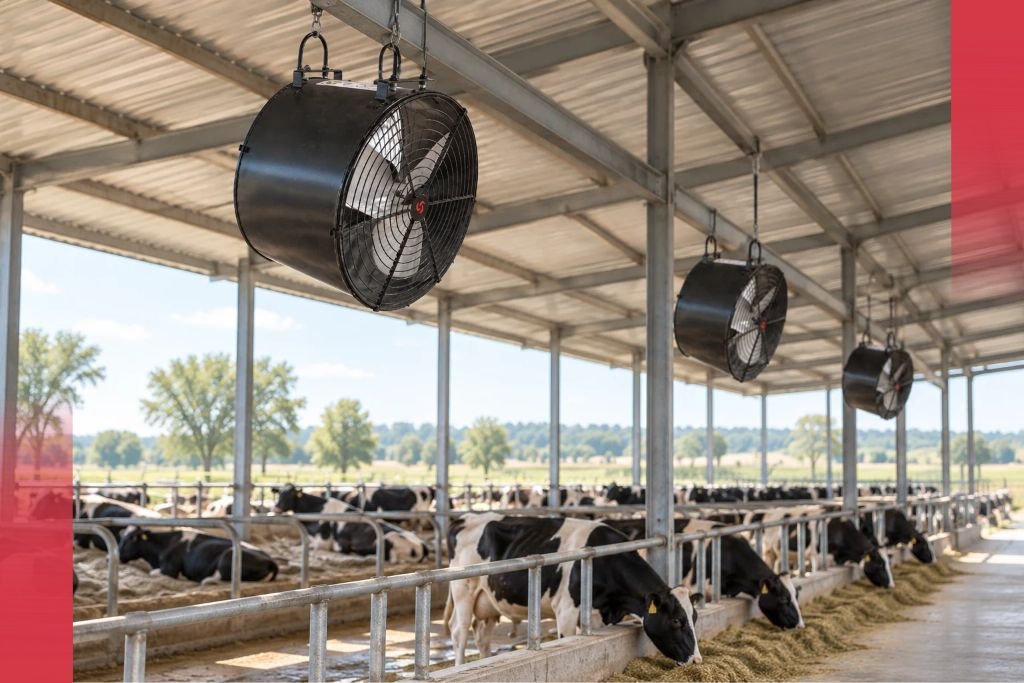
Dairy cows feel heat sooner than most farmers expect. When a shed gets warm and the air stops moving, cows lose comfort, eat less and produce less milk. Many farmers respond by adding fans. But how much air does a shed actually need, and where should the fans go? This guide explains the numbers researchers use, why they vary, and how a hanging drum fan can work as an industrial fan for dairy farm cooling in your own shed.
How Much Airflow Does a Cattle Shed Need?
There is no single number for every shed. University of Wisconsin-Madison Extension guidance for cross-ventilated dairy barns suggests about 40 to 60 air changes per hour in hot weather, roughly 1,000 to 1,500 CFM of airflow per cow, and air velocity of 2 to 5 mph over the cows. The right figure for your shed depends on climate, shed design and how many animals you house.
Treat these as starting points from published research, not guarantees. A shed in a hot, humid region may need more. A well-designed open shed in a milder climate may need less.
Why Dairy Cows Struggle With Heat
According to the same UW-Madison Extension publication, a dairy cow’s thermal comfort zone sits roughly between 40°F and 70°F (about 4°C to 21°C). Above that, she has to work to shed heat. A high-producing cow can generate over 6,000 BTUs of heat per hour from her own metabolism.
The cost shows up in the milk tank. A University of Georgia Extension bulletin on cooling systems for dairy cattle reports that heat stress can reduce summer milk production by 15 to 22 percent.
Put many cows in one shed and that heat adds up fast. Researchers often track the Temperature-Humidity Index (THI), which combines heat and humidity into one heat stress measure. Humidity matters because it makes it harder for cows to cool off.
Two Different Jobs Fans Do in a Shed
Most confusion about dairy fans comes from mixing up two separate jobs.
Job 1: Air exchange
Air exchange replaces stale, warm, humid air inside the shed with fresh outside air. The “air changes per hour” and “CFM per cow” figures describe this job. In a mechanically ventilated barn, large exhaust fans on one wall pull air through the building to achieve it.
Job 2: Air speed over the cows
Air speed describes how fast air moves across the cow’s body. Moving air helps her lose heat. Penn State Extension guidance on tunnel ventilation for tie-stall barns targets air velocities of about 300 to 440 feet per minute (3.5 to 5 mph) inside the barn.
Circulation fans, such as a hanging drum fan, mainly handle this second job. They push air across resting areas and feed alleys, even when the shed relies on open sides for air exchange. A shed often needs both jobs covered.
What Changes the Airflow Your Shed Needs
Climate and season
Hot, humid regions push THI higher for longer. Your local climate data tells you how often your cows face heat stress.
Shed width, height and roof
Penn State notes that in tunnel ventilation, fan capacity depends on the cross-sectional area of the animal space, not on the number of cows. A wider shed or a higher roof needs more fan capacity to reach the same air speed.
Herd density
More cows mean more body heat and moisture. Crowded sheds need stronger air exchange and better air distribution.
Natural ventilation
Open sidewalls, ridge openings and orientation to prevailing winds all affect how much fan support you need. Many Indian cattle sheds use open sides, which provides some air exchange but little air speed on still days. That is where circulation fans help most.
A Worked Example and Its Limits
UW-Madison Extension offers a useful illustration. A 100 ft by 400 ft cross-ventilated barn might need between 24 and 36 fans, depending on the fan model and spacing.
That example shows two things. First, the number of fans depends heavily on the fan model. Second, large mechanically ventilated barns need a designed system, usually built around large exhaust fans. For those projects, work with an agricultural engineer. UW-Madison also offers a free online calculator at go.wisc.edu/coolcows that estimates fan numbers and energy use from barn inputs.
Why a Hanging Drum Fan Works as an Industrial Fan for Dairy Farm Cooling
Floors in a cattle shed belong to the animals, the feed trolleys and the cleaning crew. A fan standing on the floor gets knocked, soiled and chewed. A hanging drum fan avoids all of that.
It stays out of reach. Clamped to roof trusses or overhead beams, the fan hangs above the cows, where they cannot rub against it or damage it.
It keeps the floor clear. Tractors, feed carts and manure scrapers can move freely without working around fan stands.
It sends air down the shed. A drum housing channels the airflow, which helps it travel along resting rows and feed alleys.
Check that the roof structure can carry the fan’s weight and vibration before installation, and plan safe electrical routing well above the animals.
The Action Aire Hanging Drum Fan
Action Aire manufactures the hanging drum fan in India. Its official catalogue describes a weatherproof construction, a rust-resistant finish, top clamping for secure installation and complete metal construction. It adds that the drum design enhances air throw for better airflow distribution, that the fan offers low sound and power consumption, and that its simple design makes maintenance easy.
The catalogue lists three models:
| Model | Size | Motor (HP) | Speed (RPM) | Wattage | Air Delivery |
| 18GHDF | 450 mm / 18″ | 1/4 | 1400 | 100W | 125 m³/min (about 4,410 CFM) |
| 20GHDF | 500 mm / 20″ | 1/4 | 1400 | 120W | 140 m³/min (about 4,940 CFM) |
| 24GHDF | 600 mm / 24″ | 1/4 | 1400 | 200W | 263 m³/min (about 9,290 CFM) |
These figures apply only to these models. We rounded the CFM values from the catalogue’s m³/min figures. Use them to plan coverage alongside research guidance, not as a replacement for a shed design.
For long sheds, spacing is as important as size. Our guide on high airflow fans for warehouse ventilation explains why several units spaced along a long building usually beat one large fan at the end.
Where to Hang the Fans
Focus the hanging drum fans on the areas where cows spend the most time:
- Resting and bedding areas, where cows lie down for long hours
- Feed alleys, so cows keep eating during hot afternoons
- Holding pens before milking, where cows stand close together
- Calf and heifer sections in mixed-use sheds
Space fans so each one’s airflow reaches the next fan’s zone. That keeps air moving along the shed instead of leaving still pockets between units.
Common Mistakes With Shed Fans
- Hanging fans too high. Air loses speed as it travels. A fan hung close to the roof ridge may barely reach cow level.
- Leaving gaps between fan zones. If one fan’s airflow dies out long before the next fan starts, cows crowd into the breezy spots.
- Fighting the natural airflow. Fans that blow against the prevailing wind or against an exhaust fan waste energy.
- Forgetting cleaning. Dust and cobwebs on guards and blades cut airflow. Clean fans before summer and during the season.
- Running fans only on the hottest afternoons. Cows start to feel heat well before the day’s peak, since their comfort zone tops out around 70°F (about 21°C).
Start With Your Shed, Then Choose the Fan
Good dairy cooling starts with knowing your shed: its size, roof height, open sides, herd size and local climate. Use published extension guidance as a reference, and involve an agricultural engineer for large or fully enclosed barns. Once you understand those factors, choosing an industrial fan for dairy farm cooling becomes a far more confident decision.
Want help planning hanging drum fans for your shed? Share your shed dimensions, roof height, truss spacing and herd size with Action Aire through the contact page, or explore the Action Aire fan range.
FAQs
How much CFM does a dairy cow need?
UW-Madison Extension guidance for cross-ventilated barns suggests roughly 1,000 to 1,500 CFM per cow in hot weather. The actual need depends on climate, barn design and herd density.
How many air changes per hour does a cattle shed need in summer?
Extension guidance for cross-ventilated dairy barns suggests about 40 to 60 air changes per hour in hot weather. Open sheds and different climates may need different rates.
What air speed should fans create over dairy cows?
UW-Madison suggests 2 to 5 mph over cows in cross-ventilated barns. Penn State tunnel ventilation guidance targets about 300 to 440 feet per minute.
Why use a hanging drum fan in a cattle shed?
It hangs above the cows, out of their reach, and keeps the floor clear for animals and equipment. The drum housing helps direct airflow along resting rows and feed alleys.
What sizes does the Action Aire hanging drum fan come in?
The catalogue lists 18, 20 and 24 inch models, with air delivery of 125, 140 and 263 m³/min respectively.
Can circulation fans replace exhaust fans in a closed barn?
No. Circulation fans create air speed, while exhaust ventilation replaces stale air. Closed barns need a designed air exchange system.
Why does humidity matter for dairy cow cooling?
High humidity makes it harder for cows to lose heat. Researchers use the Temperature-Humidity Index to measure this combined effect.